As of 24 September 2026, 61 of the 133 countries WiseTREND tracks have a B2B e-invoicing mandate that is live or phasing in, and 9 more have one scheduled by law. The dates that matter most between now and early 2028 are in France, Greece, Brazil, the UAE, Germany, Poland, Spain, Saudi Arabia, Belgium and Malaysia.
E-invoicing is no longer a European experiment. As of 24 September 2026, 61 of the 133 countries we track have a B2B e-invoicing mandate that is either live or phasing in, and 9 more have one written into law with future start dates. France went live on 1 September. Greece extends its mandate to every remaining business on 1 October. The UAE, Germany, Poland, Spain and Saudi Arabia all have hard dates between now and early 2027.
This article summarizes where things stand, explains the four ways governments run e-invoicing, and lists the ten countries we think deserve the most attention for the rest of 2026 and into 2027. The country data comes from our own research into all 133 countries. That research is refreshed every month, and the full results are published in a companion article.
Where do e-invoicing mandates stand in September 2026?
Europe, Latin America, Africa and the Gulf have moved furthest. The United States, Canada and much of the Caribbean and Pacific still have no B2B mandate at all.
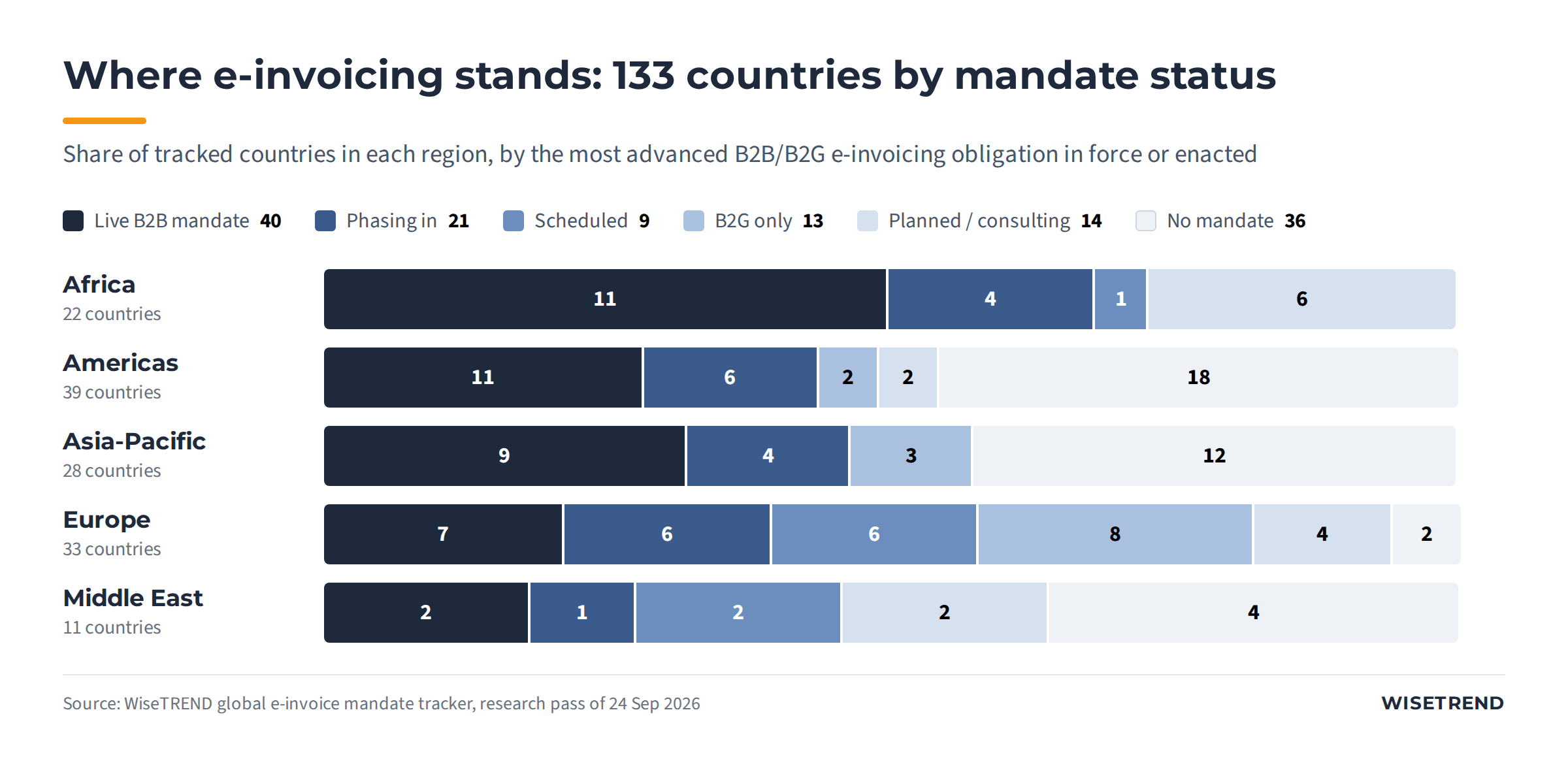
A few patterns stand out:
- Latin America built this first. Brazil, Mexico, Chile, Colombia, Argentina and their neighbors have run clearance e-invoicing for years. Their news today is mostly about new document types and tax-reform fields, not about whether e-invoicing applies.
- Europe is in the middle of its big shift. Belgium, Poland and France each moved millions of businesses onto structured e-invoices in 2026. Germany and Spain follow in 2027, and the EU-wide ViDA rules arrive on 1 July 2030.
- The Gulf is moving fast, and on Peppol. The UAE and Oman chose a Peppol-based five-corner model, while Saudi Arabia keeps extending its own clearance platform to smaller businesses.
- Africa is more active than many expect. Egypt, Kenya, Tanzania, Uganda, Rwanda, Nigeria and others already require real-time invoice reporting or fiscal devices.
- The United States remains the outlier. There is still no federal B2B mandate, although the DBNAlliance runs a voluntary exchange network.
Between our June and September research passes, 63 of the 133 countries showed at least one material change, such as a new decree, a moved date, or a phase that went live. That is almost half the countries we track, in one quarter, which is why we now refresh the research monthly.
What are the main e-invoicing models?
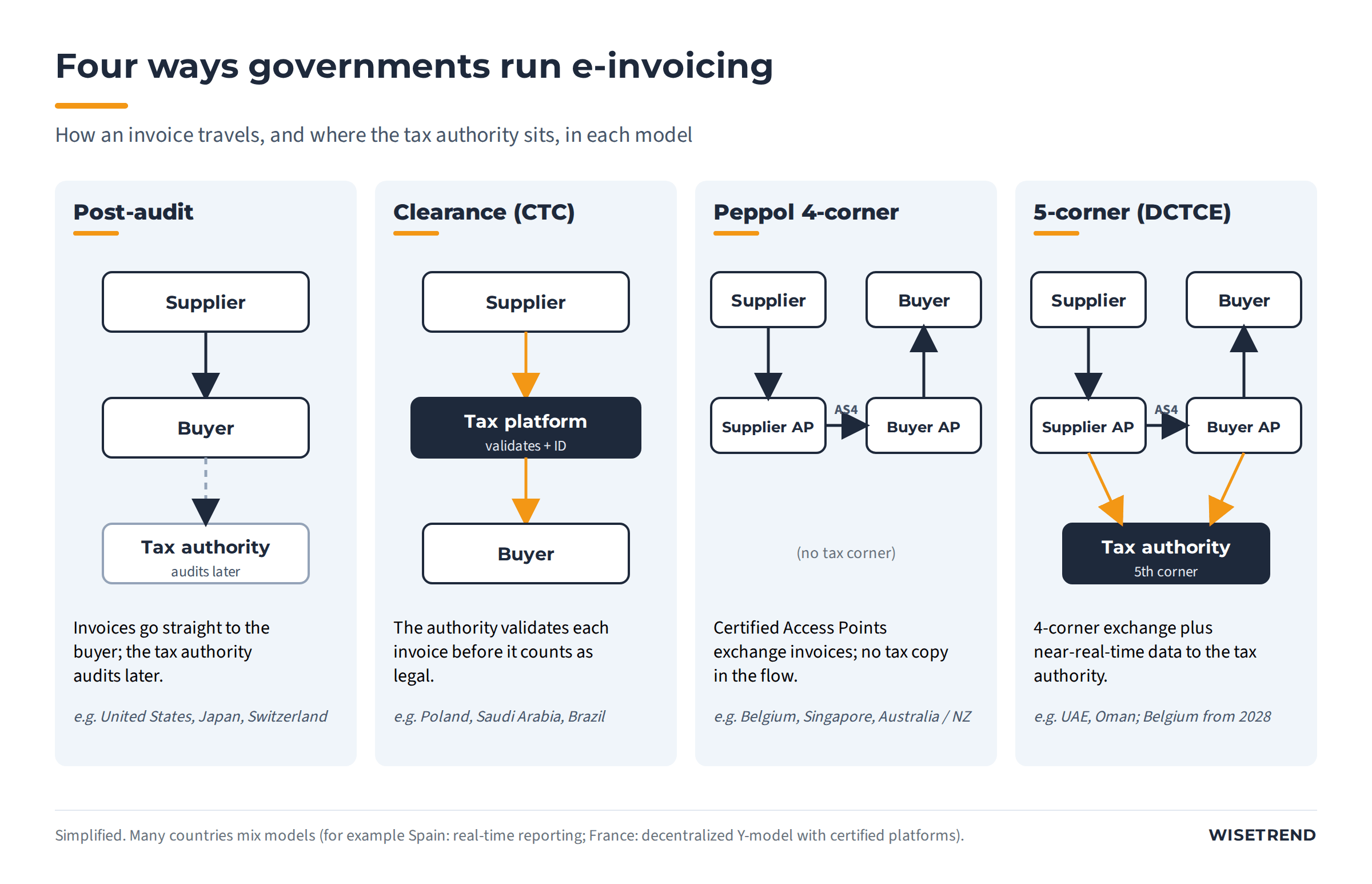
Governments use four broad models, and the model decides what your systems have to do. A clearance country needs a live connection to the tax platform before an invoice is valid. A Peppol country needs an Access Point and a registration in an SMP. A post-audit country mainly needs good archiving.
| Model | How it works | Examples |
|---|---|---|
| Post-audit | Invoices go straight to the buyer. The authority audits records later. | United States, Japan, Switzerland |
| Clearance (CTC) | The tax platform validates each invoice before it is legally issued. | Poland (KSeF), Saudi Arabia, Brazil, Malaysia, Greece |
| Peppol four-corner | Certified Access Points exchange the invoice. No tax copy in the flow. | Belgium, Singapore, Australia, New Zealand |
| Five-corner (DCTCE) | Four-corner exchange plus near-real-time data to the tax authority. | UAE, Oman; Belgium plans it for 2028 |
France uses a variant of its own: a decentralized "Y-model" where certified platforms (Plateformes Agréées) exchange invoices and pass tax data to the authority.
Which 10 countries should you watch for the rest of 2026?
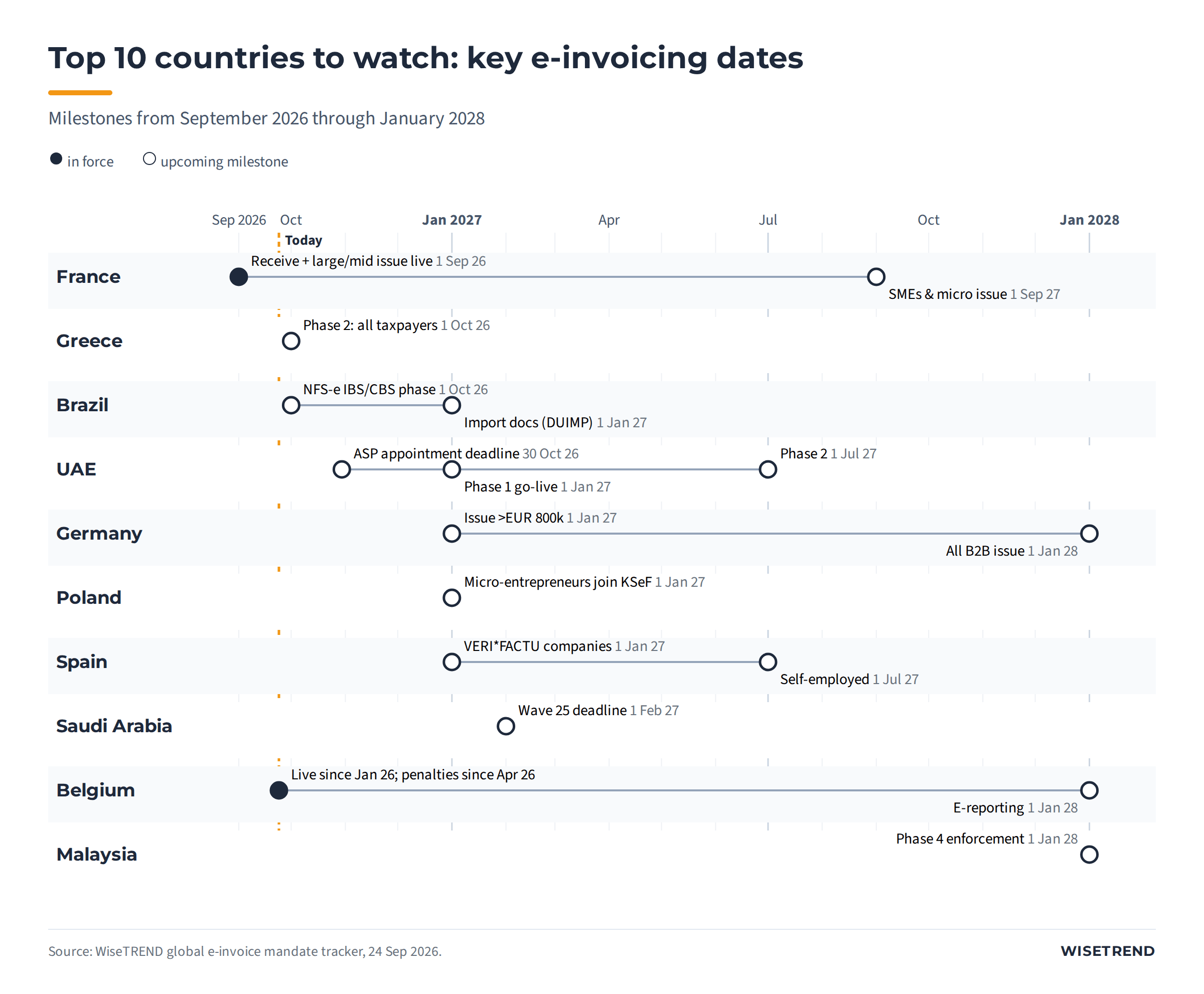
We picked these ten because each has a go-live, a deadline or an unresolved decision between now and early 2028, and each affects a large number of businesses or cross-border trading partners.
1. France: live since 1 September 2026
Every French business must now be able to receive structured e-invoices, and large and mid-sized companies must issue them and send e-reporting data. Invoices travel through certified Plateformes Agréées. The DGFiP register listed about 149 registered platforms plus 14 more awaiting interoperability tests on 22 September. Small and micro businesses start issuing on 1 September 2027. Market reports suggest penalties will be applied leniently in 2026 for businesses making a genuine effort, but we found no formal DGFiP text confirming that, so plan to comply rather than rely on tolerance.
2. Greece: everyone else joins on 1 October 2026
Mandatory B2B e-invoicing through AADE's myDATA went live for businesses with more than EUR 1 million in revenue on 2 March 2026. From 1 October 2026, all remaining Greek taxpayers must comply. Businesses that want the transition period must declare it by 12 October, and parallel issuance is allowed until 31 December 2026.
3. Brazil: tax reform fields and new document calendars
Brazil's e-invoices have been mandatory for years. What is new is the CBS/IBS dual-VAT reform. The new tax fields became mandatory on most e-documents on 3 August 2026, although automatic rejection of documents without them was suspended on 31 July. A joint act published on 30 July adds the national service invoice (NFS-e) and other documents from 1 October 2026, digital platforms from 1 December 2026, and import declarations from 1 January 2027.
4. United Arab Emirates: Peppol-based mandate from 1 January 2027
The UAE pilot started on 1 July 2026. Large taxpayers (revenue above AED 50 million) must appoint an Accredited Service Provider by 30 October 2026 and go live on 1 January 2027. Smaller businesses follow on 1 July 2027, government entities on 1 October 2027. The format is PINT AE, a UAE specialization of the Peppol international invoice.
5. Germany: issuing becomes mandatory from 1 January 2027
All German businesses have had to receive structured e-invoices since January 2025. From 1 January 2027, businesses with prior-year turnover above EUR 800,000 must also issue them, and from 1 January 2028 every domestic B2B supplier must. XRechnung, ZUGFeRD (from version 2.0.1, excluding the MINIMUM and BASIC-WL profiles) and Peppol BIS Billing 3.0 all qualify.
6. Poland: KSeF is live, micro businesses join in 2027
Poland's national clearance system, KSeF, went live for large taxpayers on 1 February 2026 and for almost everyone else on 1 April 2026. Micro-entrepreneurs join on 1 January 2027. In mid-September the Ministry of Finance proposed delaying KSeF error penalties to 1 January 2028. That is still a proposal that needs a new law; the obligation to use KSeF is not affected.
7. Spain: three regimes, one date still unset
Spain has three regimes. VERIFACTU, which requires certified, tamper-proof billing software, starts on 1 January 2027* for companies and 1 July 2027 for the self-employed. The B2B e-invoicing mandate under the "Crea y Crece" law has a Royal Decree in force since April 2026, but it only starts counting once a Ministerial Order is published, and that order had not appeared by 24 September. When it does, larger businesses get 12 months and everyone else 24.
8. Saudi Arabia: Wave 25 brings in smaller businesses
ZATCA keeps lowering the threshold for Phase 2 integration with its Fatoora platform. Wave 24 finished on 30 June 2026. Wave 25, announced on 24 July, covers businesses with more than SAR 187,500 in VAT-able revenue and must integrate by 1 February 2027. That reaches almost every VAT-registered business.
9. Belgium: live, enforced, and adding e-reporting in 2028
Belgium's Peppol-based B2B mandate has been live since 1 January 2026. The tolerance period ended on 31 March, and fines now apply: EUR 1,500 for a first violation, rising to EUR 3,000 and EUR 5,000 for repeats. The next step is near-real-time e-reporting through a five-corner model from 1 January 2028. Our Belgium guide covers the details.
10. Malaysia: phases 1 to 4 live, enforcement relaxed to 2028
Malaysia's MyInvois clearance system covers four phases by turnover. Phase 4 (RM1 million to RM5 million) started on 1 January 2026, but in April the government extended its penalty-free period to 31 December 2027. Full enforcement for that group now starts on 1 January 2028. Businesses below RM1 million are permanently exempt.
Honorable mentions
- Oman: a decision published on 9 August 2026 makes e-invoicing mandatory from 1 April 2027 for businesses with supplies above OMR 5 million, and from 1 October 2027 for everyone else, on a Peppol-based five-corner model.
- Netherlands: on 11 September 2026 the Cabinet announced domestic B2B e-invoicing from 1 July 2030 and domestic e-reporting from 1 July 2031. Legislation still has to pass.
- United Kingdom: mandatory e-invoicing for all VAT invoices from April 2029 is confirmed. The detailed roadmap is expected with the Autumn 2026 Budget.
- Singapore: InvoiceNow over Peppol is being phased in for GST-registered businesses, with the compulsory phases running from 1 April 2028 to 2031.
- Japan: no mandate, but the input tax credit for purchases from non-registered suppliers drops from 80% to 50% on 1 October 2026.
What should finance and AP teams do now?
The practical work is similar everywhere, even though the rules differ:
- Map entities to mandates. List every legal entity, its country, and the date it must receive, issue or report e-invoices. Include the trading partners that will start sending you e-invoices.
- Pick the channel per country. Peppol in Belgium, Singapore, the UAE and Oman; the national platform in Poland, Saudi Arabia and Malaysia; certified platforms in France. One provider rarely covers all of them, so plan for a small number of connections.
- Keep capturing paper and PDF. Mandates do not end OCR. Suppliers in non-mandate countries, small vendors, expense documents and cross-border invoices will keep arriving as PDFs for years, so your AP process has to handle both.
- Validate before posting. Structured does not mean correct. Run EN 16931 and country rules, then your own business rules (PO matching, vendor master checks) on every invoice, whatever channel it came from.
- Track the dates monthly. Almost half the countries we follow changed something in a single quarter. Put an owner and a calendar on this.
WiseTREND is a Peppol-certified Access Point and SMP provider and has automated invoice processing on ABBYY for close to two decades, so paper, PDF and e-invoices can run through one AP and AR pipeline. Talk to our team if you want help mapping your entities to the dates above.
Sources: WiseTREND global e-invoice mandate research, 24 September 2026, drawing on tax authority publications (AADE, DGFiP, BMF, Ministry of Finance of Poland, AEAT/BOE, ZATCA, UAE Ministry of Finance, Oman Tax Authority, IRBM) and tracker reports from VATupdate, EY, KPMG, Sovos and Avalara. Dates can change; confirm against the official source before acting.