WiseTREND's 24 September 2026 research pass covered 133 countries. 40 have a live B2B e-invoicing mandate, 21 are phasing one in, 9 have one scheduled, 13 mandate e-invoices only for government purchases, 14 are planning one, and 36 have none. Peppol is central to the framework in 21 countries. 63 countries had at least one material change since June 2026.
Our September 2026 deep research into e-invoicing covered 133 countries in five regions. The short version: 40 countries have a live B2B e-invoicing mandate, 21 are phasing one in, and 9 more have one scheduled by law. Another 13 require e-invoices only for government purchases, 14 are planning or consulting, and 36 have no mandate. Peppol is central to the framework in 21 countries. And between our June and September research, 63 countries had at least one material change.
This article explains how we did the research, what we found, and ends with a simplified country-by-country table dated 24 September 2026. For the ten countries we think matter most right now, see State of e-Invoice Mandates in 2026: Top 10 Countries to Watch.
Why do we track e-invoicing in 133 countries?
We run AP and AR automation for organizations that buy and sell across borders, and we operate a Peppol Access Point and SMP. Our clients' questions are rarely about one country. They sound like "which of our 14 entities have to issue e-invoices next year, and through what channel?" Public trackers are helpful, but they vary in freshness, and a single outdated date can put an entity out of compliance.
So we keep our own tracker: one row per country, columns for status, dates, model, authority, technical specifications, Peppol role, archiving period and sources, plus a new research column every time we refresh it. The first research passes ran in April and June 2026. The September pass is the first one where every country gets two clearly separated sections: Current e-Invoice Mandates, and Changes since last research.
How did we research 133 countries?
We used AI research agents, but with rules that we set and checks that we enforce.
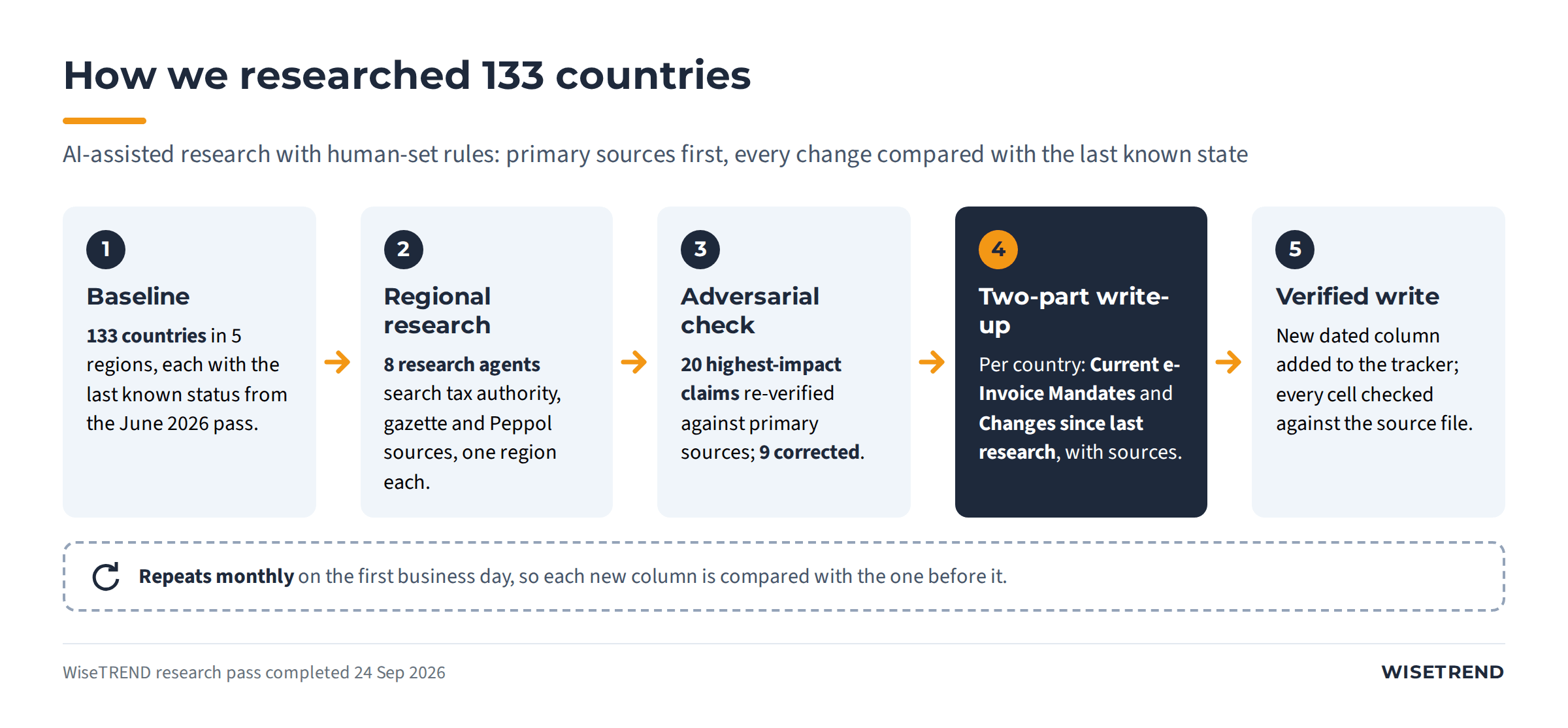
- Baseline. Each country starts from its last known state, taken from the June 2026 research.
- Regional research. Eight agents work in parallel, one region or sub-region each. They must search current sources for every country: tax authorities, official gazettes, OpenPeppol, and tracker reports from firms such as VATupdate, EY, KPMG, PwC, Sovos and Avalara. Answers from memory are not allowed, and every claim needs a source.
- Adversarial check. A second set of agents takes the 20 highest-impact claims (new dates, go-lives, decree numbers, postponements) and tries to disprove each one against primary sources. That step corrected 9 of the 20. Examples: a Polish penalty delay that is still only a proposal, a Luxembourg bill with two phases rather than three, and an Omani decision that turned a planned August 2026 phase into a voluntary pilot.
- Two-part write-up. Every country gets the same structure: the current state first, then the delta against the previous pass, with each change labelled as new, changed, went live as scheduled, or corrected.
- Verified write. The new column is added to the tracker, and every cell is compared with the source file after writing.
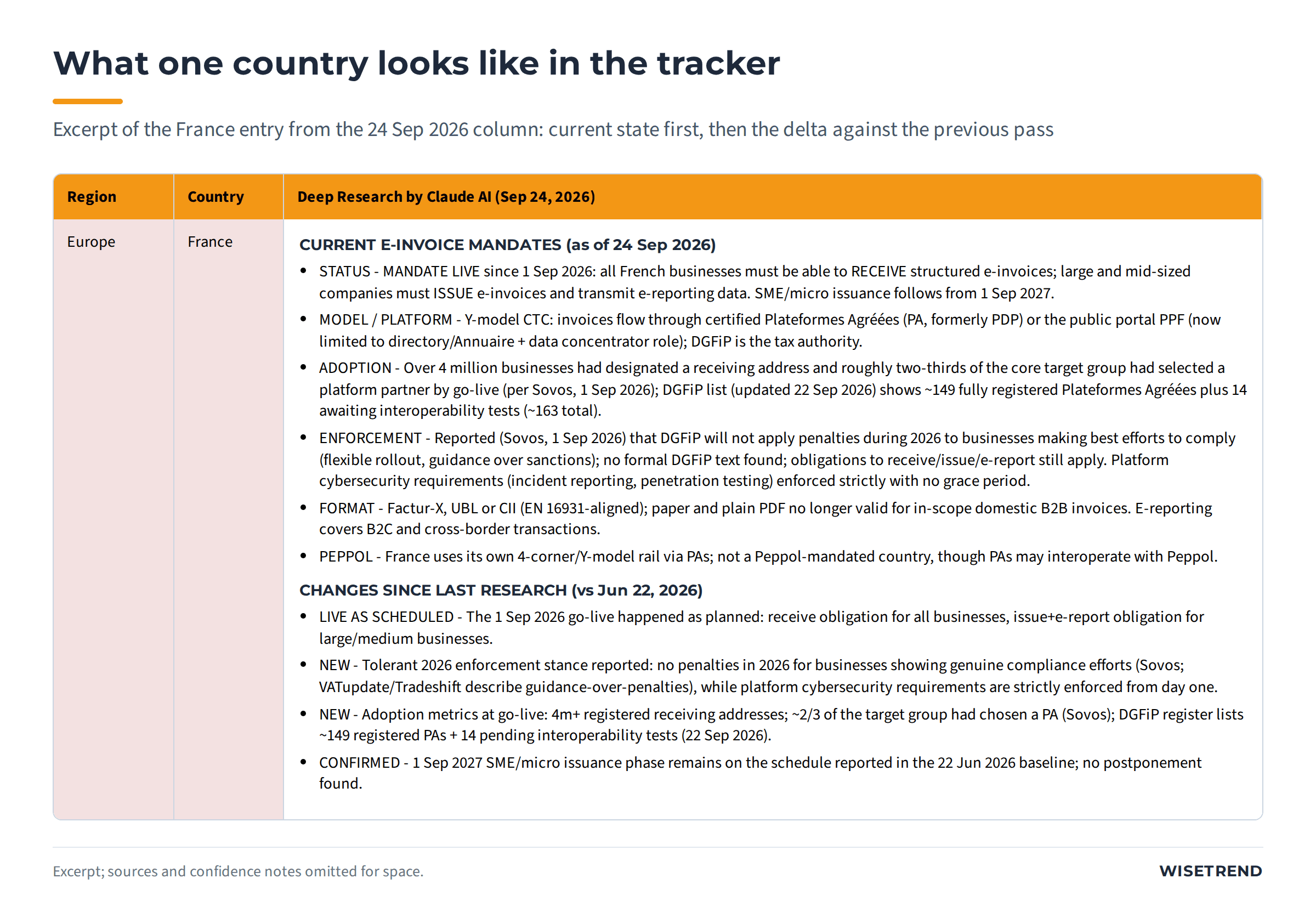
Here is what one country looks like in the tracker:
The same process now runs automatically on the first business day of every month, so each column is compared with the one before it.
What did the research find?
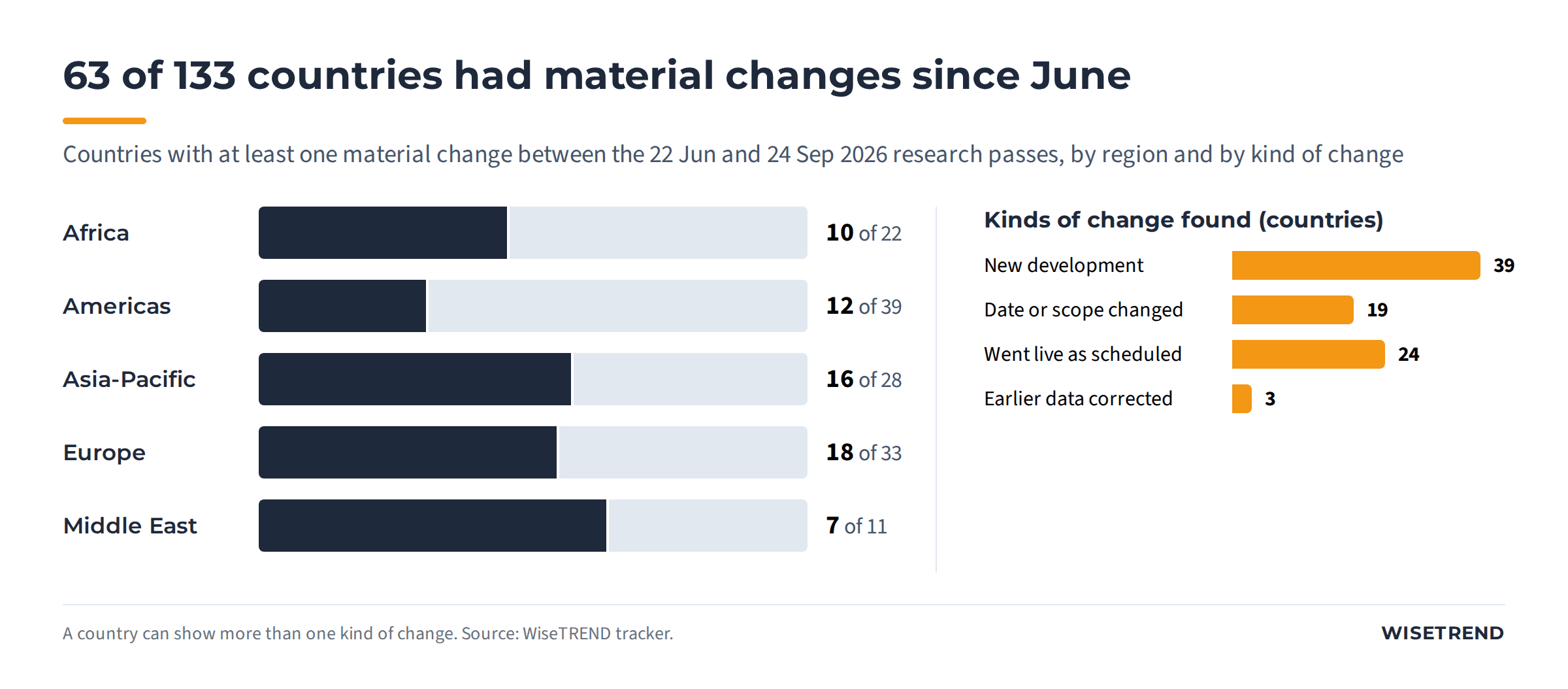
Almost half the countries we track moved in one quarter. 63 of 133 countries showed at least one material change between 22 June and 24 September 2026. The most common kind was a new development (39 countries), followed by phases that went live on schedule (24) and changed dates or scope (19).
Other findings worth knowing:
- Most 2026 go-lives happened on time. France (1 September), Belgium's end of tolerance (31 March), Poland's two KSeF waves (February and April), Croatia's Fiscalization 2.0 (January) and the UAE pilot (July) all started as scheduled. Postponements still happen (Greece moved its first phase by one month, to March), but none of the major go-lives due between June and September slipped.
- Where dates moved, enforcement moved later more often than the mandate itself. Malaysia extended penalty relief for its smallest mandated tier to the end of 2027, and Poland proposed delaying KSeF error penalties for all taxpayers to 2028, while the obligations themselves stay in force.
- New mandates keep appearing. Oman made e-invoicing law in August 2026, the Netherlands announced a 2030 domestic B2B mandate, and Luxembourg tabled a bill with 2028 and 2029 phases.
- Clearance remains the dominant model outside Europe. Latin America, much of Africa and Asia, and Saudi Arabia validate invoices on a government platform before they count.
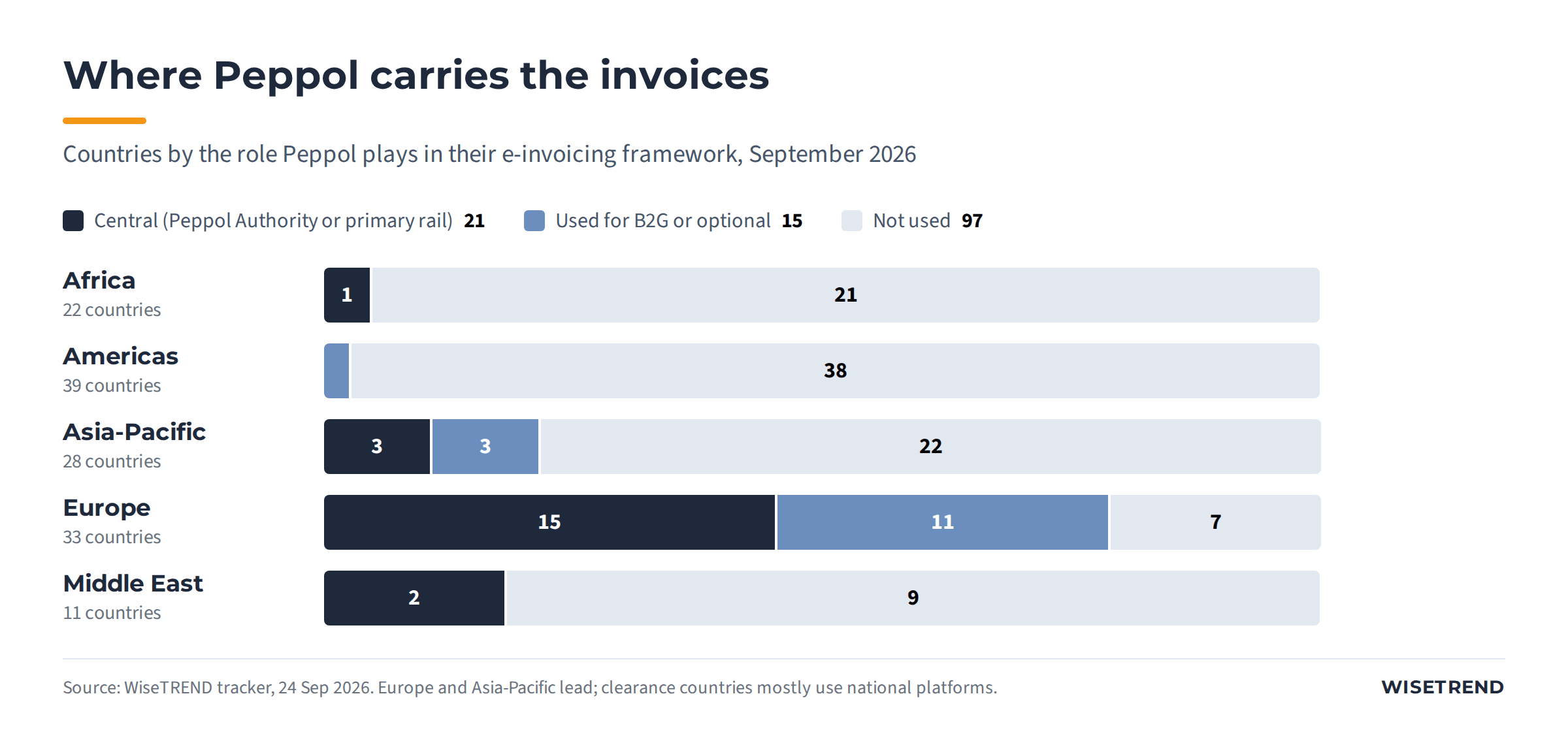
- Peppol's footprint is concentrated but growing. Peppol is central in 21 countries, mostly in Europe and Asia-Pacific. The newest additions are in the Gulf, where the UAE and Oman chose Peppol-based five-corner models.
How should you read the table below?
The table simplifies each country to a status, a one-line summary with key dates, and Peppol's role. Status uses one of six categories:
| Status | Meaning |
|---|---|
| Live B2B mandate | A B2B e-invoicing, clearance or real-time invoice reporting obligation is in force for at least the largest businesses. |
| Phasing in | Enacted and partly live, with more waves due within about two years. |
| Scheduled | Enacted with dates, not yet live for B2B. |
| B2G only | Only invoices to government bodies must be electronic. |
| Planned / consulting | Announced, drafted or piloted, with no binding B2B date yet. |
| No mandate | Nothing concrete found. |
Peppol is "Yes" where the country is a Peppol Authority with active domestic use or where Peppol is the mandated or primary exchange rail, "B2G / partial" where it is used for government invoicing or offered as an option, and "No" otherwise. Countries listed in two regions in our tracker (Turkey) appear once.
e-Invoice and Peppol status by country, 24 September 2026
Africa (22 countries)
| Country and status | Current state and key dates | Peppol |
|---|---|---|
| Algeria Planned / consulting | No mandatory e-invoicing regime yet; a voluntary B2G pilot continues while a mandatory launch date keeps slipping. Key dates: Voluntary B2G pilot since 2023; mandatory launch slipped, possibly 2027 (unconfirmed) | No |
| Angola Phasing in | Certified e-invoicing with tax-authority validation is live for large taxpayers and extends to all VAT taxpayers in Oct 2026. Key dates: Phase 1 (large taxpayers) from 1 Jan 2026; Phase 2 (all VAT taxpayers) from 1 Oct 2026 | No |
| Botswana Planned / consulting | E-invoicing via mandatory fiscal devices has been enacted in law but no commencement date has been set yet. Key dates: Law enacted (gazetted 31 Oct 2025); no commencement date gazetted yet | No |
| Cameroon Scheduled | Cameroon has enacted a 2026 e-invoicing mandate for all taxable persons, launching first with major revenue-generating sectors. Key dates: 2026 Finance Law mandate; rollout starts 2026 with telecom/brewing/cement/betting sectors first (exact date pending) | No |
| DR Congo Live B2B mandate | Standardized e-invoice clearance has been mandatory for VAT-liable businesses since Dec 2025, with sanctions now enforced. Key dates: Mandatory since 1 Dec 2025; sanctions enforced from 15 May 2026 | No |
| Egypt Live B2B mandate | Real-time clearance e-invoicing is mandatory for all VAT-registered businesses, with B2C e-receipts also expanding. Key dates: Live since Apr 2023 (all VAT taxpayers); SME onboarding deadline 31 Mar 2026 (passed) | No |
| Ghana Phasing in | E-VAT clearance already covers most VAT businesses, with a nationwide fiscal-device rollout targeted for late 2026. Key dates: E-VAT near-full coverage by 2025; VAT Act 2025 in force 1 Jan 2026; nationwide fiscal-device rollout targeted Q4 2026 | No |
| Ivory Coast Live B2B mandate | Real-time e-invoice clearance (FNE) is mandatory across all taxpayer regimes, with paper invoices no longer accepted. Key dates: Launched 1 Jul 2025; paper invoices rejected since 1 Dec 2025; migration deadline 31 Jan 2026 | No |
| Kenya Live B2B mandate | eTIMS e-invoicing is mandatory for all businesses issuing tax invoices, and only eTIMS-backed expenses remain tax deductible. Key dates: Mandatory since 2023/Jan 2024; only eTIMS-backed expenses deductible from 2026 | No |
| Mauritius Phasing in | Mandatory e-invoicing is live for larger businesses and is being phased down to smaller taxpayers by turnover. Key dates: Phase 1 (>MUR100m) live 15 May 2024; scope widened to >MUR80m; further phases planned, undated | No |
| Morocco Planned / consulting | A 2026 mandatory e-invoicing rollout has been announced, but the exact start date and thresholds await a government decree. Key dates: 2026 target announced; exact start date and thresholds still pending implementing decree | No |
| Mozambique Live B2B mandate | No full e-invoicing clearance, but mandatory monthly VAT invoice e-reporting via certified software has applied since May 2025. Key dates: Mandatory monthly VAT invoice e-reporting since May 2025 | No |
| Namibia Planned / consulting | No mandatory e-invoicing yet; a phased clearance regime is planned with mandatory rollout not expected before 2028. Key dates: Mandatory implementation not expected before 2028 | No |
| Nigeria Phasing in | Real-time clearance e-invoicing is rolling out by taxpayer size, with the tax authority also a registered Peppol Authority. Key dates: Phase 1 (>=NGN 5bn) live, enforced from 31 Jul 2026; Phase 2 (NGN1-5bn) from 1 Jul 2026; Phase 3 2027-2028 | Yes |
| Rwanda Live B2B mandate | Real-time certified e-invoicing through electronic billing machines has been mandatory for all taxable persons since 2021. Key dates: Mandatory real-time certified invoicing since 1 Jan 2021 | No |
| Senegal Planned / consulting | Senegal has a legal basis for mandatory e-invoicing but no published go-live date or final technical specification. Key dates: Legal basis from 2025 Finance Law; no go-live date published | No |
| South Africa Planned / consulting | South Africa has enacted the legal basis for a future Peppol-based e-invoicing regime, with full rollout targeted around 2028. Key dates: Legal basis (TALAB) enacted 1 Apr 2026; phased rollout 2026-2029; full operation targeted around 2028 | No |
| Tanzania Live B2B mandate | Real-time fiscal-device reporting to the tax authority is mandatory for VAT traders and larger non-VAT traders. Key dates: Fiscalisation mandatory since 2010/2013; piloting move to token-based clearance | No |
| Tunisia Live B2B mandate | Mandatory e-invoicing now covers all VAT-registered service businesses; extension to the goods sector remains undated. Key dates: Extended to all VAT-registered service businesses 1 Jan 2026; goods sector extension undated | No |
| Uganda Live B2B mandate | EFRIS real-time e-invoicing has been mandatory for VAT taxpayers since 2021 and keeps expanding to more sectors. Key dates: VAT taxpayers since Jan 2021; 12 more sectors added 1 Jul 2025; further sectors from Aug 2026 | No |
| Zambia Live B2B mandate | Smart Invoice real-time e-invoicing is mandatory for VAT-registered taxpayers, and input VAT deductions now require it. Key dates: Mandatory since 2023; input VAT deduction restricted to Smart Invoice from 1 Jan 2025/2026 | No |
| Zimbabwe Live B2B mandate | Fiscalised e-invoicing is mandatory for VAT operators and is expanding to non-VAT taxpayers and the fuel sector. Key dates: Mandatory since 2022-era rules; extended to non-VAT taxpayers (2025) and fuel sector (SI 88/2026) | No |
Americas (39 countries)
| Country and status | Current state and key dates | Peppol |
|---|---|---|
| Antigua and Barbuda Planned / consulting | No e-invoicing mandate yet; the government has announced plans to digitize sales-tax administration, including e-invoicing, no timeline set. | No |
| Argentina Phasing in | Electronic invoicing is mandatory for nearly all taxpayers, with remaining financial-sector waves rolling out through early 2027. Key dates: Staggered rollout Sep 2026-Mar 2027 by sector (insurers Sep 2026, banks Oct 2026, card issuers Dec 2026, co-insurance Mar 2027) | No |
| Aruba No mandate | There is no e-invoicing mandate; Aruba has not yet even implemented VAT, still targeted for 2027 or later. | No |
| Bahamas No mandate | E-invoicing is permitted but not mandatory for B2G, B2B or B2C, with no published rollout plan. | No |
| Barbados No mandate | There is no e-invoicing mandate; the tax authority's online portal supports e-filing but not invoice clearance. | No |
| Belize Planned / consulting | E-invoicing has been approved in principle for GST-registered businesses, with a working 2027 target but no published technical timeline. Key dates: Projected mandatory go-live 2027 (exact dates/thresholds unpublished) | No |
| Bolivia Phasing in | Mandatory e-invoicing is nearly complete nationwide, with the final taxpayer groups required to switch by October 2026. Key dates: Groups 1-8 mandatory; Groups 9-12 deadline 30 Sep 2026, all taxpayers from 1 Oct 2026 | No |
| Caribbean Netherlands No mandate | There is no e-invoicing mandate for these special Dutch municipalities, and the Netherlands' Peppol B2B plans do not extend here. | No |
| Brazil Phasing in | Long-standing e-invoice clearance is mandatory nationwide, now extended with a detailed 2026-2027 calendar for the new dual-VAT reform. Key dates: IBS/CBS fields mandatory from 3 Aug 2026; NFS-e/NFCom phase 1 Oct 2026; further phases Nov 2026-Jan 2027 | No |
| Canada B2G only | No federal B2B e-invoicing mandate; electronic invoicing via Peppol is mandatory for suppliers to the federal government. Key dates: B2G mandatory since Apr 2022 | B2G / partial |
| Chile Live B2B mandate | Electronic tax documents (DTE) are mandatory for all VAT taxpayers, with new dispatch-guide traceability rules taking effect Nov 2026. Key dates: Digital boleta delivery since 1 Mar 2026; dispatch-guide traceability deferred to 1 Nov 2026 | No |
| Colombia Live B2B mandate | Pre-clearance e-invoicing is mandatory and fully operational for B2B, B2C and B2G transactions nationwide. Key dates: Same-day DIAN transmission now enforced; electronic POS tickets (DEE) phased rollout through 2026 | No |
| Costa Rica Live B2B mandate | Real-time pre-clearance e-invoicing is mandatory nationwide for all VAT taxpayers. Key dates: Version 4.4 mandatory since Sep 2025 | No |
| Cuba No mandate | There is no e-invoicing mandate or technical framework; the topic remains under government study only. | No |
| Curaçao No mandate | There is no e-invoicing mandate; a broader VAT reform remains in planning with no firm implementation date. | No |
| Dominica No mandate | There is no e-invoicing mandate; VAT is administered through conventional post-audit processes. | No |
| Dominican Republic Phasing in | Mandatory e-invoicing (e-CF) is rolling out by taxpayer size, with all remaining groups required to switch by mid-November 2026. Key dates: Large/Medium taxpayers exclusive e-CF from 1 Nov 2026; Micro/Small/unclassified by 15 Nov 2026 | No |
| Ecuador Live B2B mandate | Pre-clearance e-invoicing is mandatory for nearly all taxpayers, with real-time transmission now covering about 94% of transactions. Key dates: Real-time transmission mandatory since 1 Jan 2026; software-provider registration deadline 9 Sep 2026 | No |
| El Salvador Live B2B mandate | Mandatory electronic tax documents (DTE) are already in force, with a major DTE 2.0 overhaul becoming mandatory in December 2026. Key dates: DTE mandatory (phased by taxpayer); DTE 2.0 mandatory from 1 Dec 2026 | No |
| Grenada No mandate | There is no e-invoicing mandate; the tax authority's portal supports online filing and payment, not invoice clearance. | No |
| Guatemala Live B2B mandate | Electronic invoicing (FEL) is mandatory and essentially universal across the taxpayer base. Key dates: FEL mandatory, near-universal; Agencia Virtual-only filing for large VAT taxpayers from 1 Sep 2026 | No |
| Guyana No mandate | There is no e-invoicing mandate; VAT invoicing remains standard paper-based tax invoicing under existing law. | No |
| Haiti No mandate | There is no e-invoicing mandate or fiscalization framework; taxes are administered through conventional channels. | No |
| Honduras Phasing in | Electronic invoicing is mandatory for most general-regime taxpayers and is still being extended toward full nationwide coverage. Key dates: Phased rollout ongoing; most general-regime taxpayers already obligated | No |
| Jamaica No mandate | There is no e-invoicing mandate; a proposed tax-authority e-invoicing system has not been adopted by government. | No |
| Mexico Live B2B mandate | Real-time clearance e-invoicing (CFDI) is mandatory nationwide for virtually all business transactions. Key dates: CFDI 4.0 mandatory nationwide; digital-platform data rule (2.9.21) eff. 1 Apr 2026 | No |
| Nicaragua No mandate | There is no nationwide e-invoicing mandate; businesses may request authorization to issue electronic invoices voluntarily. | No |
| Panama Live B2B mandate | Electronic invoicing is mandatory nationwide, with businesses above free-tool thresholds required to use an authorized provider. Key dates: Free-tool thresholds (B/.36,000; 100 docs/month) effective 1 Jan 2026 | No |
| Paraguay Phasing in | Mandatory e-invoicing is being phased in by taxpayer group, with new groups added roughly every few months through 2027. Key dates: Group 19 Jun 2026; Group 20 Sep 2026; Group 21 Dec 2026; Group 22 Mar 2027; Groups 23-24 through Sep 2027 | No |
| Peru Live B2B mandate | Pre-clearance electronic invoicing (CPE) is mandatory for virtually all taxpayers, including new businesses from their first day. Key dates: New RUC registrants electronic emitters from day one since 1 Jun 2026 | No |
| Puerto Rico (US Territory) No mandate | There is no clearance-style e-invoicing mandate; sales tax is administered via mandatory e-filing, not centrally cleared invoices. | No |
| Saint Kitts and Nevis No mandate | There is no e-invoicing mandate; B2B e-invoicing remains voluntary with no legislation or timeline announced. | No |
| Saint Lucia No mandate | There is no e-invoicing mandate; e-invoicing remains voluntary with no legislation or timeline announced. | No |
| Saint Vincent and the Grenadines No mandate | There is no e-invoicing mandate; B2B e-invoicing remains voluntary with no legislation or timeline announced. | No |
| Suriname No mandate | There is no structured e-invoicing mandate; VAT digitalization refers to registration and compliant cash registers, not invoice clearance. | No |
| Trinidad and Tobago No mandate | There is no e-invoicing mandate; VAT is administered on a conventional post-audit basis. | No |
| United States B2G only | No federal B2B e-invoicing mandate exists; only intra-government B2G invoicing is mandatory, with a voluntary industry network. | No |
| Uruguay Live B2B mandate | Electronic tax receipts (CFE) are mandatory for essentially all VAT taxpayers, with universal adoption already complete. Key dates: CFE format v25.2 in production since 30 Jun 2026 | No |
| Venezuela Live B2B mandate | Digital invoicing is mandatory only for businesses trading exclusively via electronic/online channels; others may adopt it optionally. Key dates: Effective 1 Mar 2025; expanded to all electronic-channel operations 19 Mar 2026 | No |
Asia-Pacific (28 countries)
| Country and status | Current state and key dates | Peppol |
|---|---|---|
| Australia B2G only | No mandatory B2B e-invoicing; government agencies must receive a share of invoices via Peppol, used by 400,000+ businesses. Key dates: Government agencies must receive 30% of invoices via Peppol by 1 Jul 2026; full automation target Dec 2026 | Yes |
| Bangladesh No mandate | There is no nationwide e-invoicing mandate; fiscal devices apply only to specific outlets, and VAT modernization focuses on e-filing. | No |
| Bhutan No mandate | A new GST regime went live in 2026, but there is no dedicated structured e-invoicing or clearance mandate. | No |
| Brunei No mandate | There is no e-invoicing mandate and no VAT/GST; a government e-invoice portal exists only for public-sector transactions. | No |
| Cambodia B2G only | E-invoicing is mandatory only for government transactions so far, with a defined-taxpayer B2B mandate targeted to begin in 2026. Key dates: B2G expanded to 14 ministries by 20 Nov 2025; B2B mandatory rollout targeted 2026 (undated) | No |
| China Live B2B mandate | Fully digitalized e-fapiao clearance is now the sole legal invoice format nationwide under China's new VAT Law. Key dates: Nationwide from 1 Dec 2024; unified VAT Law in force since 1 Jan 2026 | No |
| Hong Kong No mandate | There is no e-invoicing mandate; e-invoicing is entirely voluntary and Hong Kong has no general VAT or GST. | No |
| India Live B2B mandate | Clearance-style GST e-invoicing is mandatory for B2B and export transactions above a turnover threshold, with no B2C mandate yet. Key dates: Mandatory for AATO >= INR 5 crore; AATO >= INR 10 crore must report within 30 days | No |
| Indonesia Live B2B mandate | Clearance-style VAT e-invoicing (e-Faktur via Coretax) is mandatory for essentially all VAT-registered taxpayers. Key dates: Coretax launched 1 Jan 2025; legacy e-Faktur fully replaced by 31 Dec 2025 | No |
| Japan No mandate | There is no mandatory e-invoicing regime; a voluntary Peppol standard (JP PINT) exists alongside a qualified-invoice tax-credit system. Key dates: Input-tax-credit relief for non-qualified suppliers steps down to 50% from 1 Oct 2026 | B2G / partial |
| Laos No mandate | There is no e-invoicing mandate; businesses issue invoices on their own template with no government clearance required. | No |
| Macau No mandate | There is no e-invoicing mandate and no VAT/GST; the new 2026 Tax Code does not introduce either. | No |
| Malaysia Phasing in | Clearance e-invoicing is live in phases by turnover, though the smallest mandated tier's enforcement has been pushed back to 2028. Key dates: Phase 1 1 Aug 2024; Phase 2 1 Jan 2025; Phase 3 1 Jul 2025; Phase 4 1 Jan 2026 (enforcement relaxed to 1 Jan 2028) | B2G / partial |
| Maldives No mandate | There is no structured e-invoicing mandate; GST uses online filing, with new rules for overseas tourism suppliers from Oct 2026. | No |
| Mongolia Live B2B mandate | Real-time e-receipt/e-invoicing (eBarimt) has been mandatory for B2B, B2G and B2C VAT-relevant transactions since 2016. Key dates: eBarimt 2.0 since 1 Jan 2020; original mandate since 1 Jan 2016 | No |
| Myanmar No mandate | There is no e-invoicing mandate; paper-based invoicing continues under the commercial tax system. | No |
| Nepal Live B2B mandate | Near-real-time e-billing is mandatory for VAT-registered businesses above a turnover threshold and designated high-risk sectors. Key dates: Mandatory turnover threshold cut to NPR 200 million from Apr 2026 | No |
| New Zealand B2G only | No general B2B mandate; Peppol e-invoicing is effectively mandatory for central government, expanding to large suppliers by 2027. Key dates: Rule 44 e-invoice capability for large-volume agencies since 1 Jan 2026; large-supplier Peppol requirement from 1 Jan 2027 | Yes |
| Pakistan Live B2B mandate | Real-time digital invoicing clearance is now fully mandatory for all sales-tax-registered persons nationwide. Key dates: Fully live for all sales-tax-registered persons since 31 Dec 2025; service-sector expansion via SRO 288(I)/2026 | No |
| Papua New Guinea No mandate | There is no e-invoicing mandate; GST is administered through a standard post-audit online filing portal. | No |
| Philippines Phasing in | Near-real-time e-invoice reporting is mandatory for large taxpayers, with a consolidated December 2026 deadline for other major groups. Key dates: Consolidated deadline 31 Dec 2026 for e-commerce sellers, large taxpayers and CAS/CBA users | No |
| Singapore Phasing in | GST InvoiceNow e-invoicing over the Peppol network is being phased in as mandatory for GST-registered businesses through 2031. Key dates: Wave 2 all new voluntary registrants 1 Apr 2026; compulsory registrants from 1 Apr 2028; full rollout by 1 Apr 2031 | Yes |
| South Korea Live B2B mandate | Near-real-time electronic tax invoicing is mandatory for corporations and qualifying individual businesses. Key dates: Sole-proprietor threshold KRW 80m since 1 Jul 2024 | No |
| Sri Lanka Phasing in | Real-time VAT e-invoicing is rolling out starting with export-oriented enterprises, targeting all VAT-registered businesses by end of 2026. Key dates: Phase 1 export-oriented enterprises in progress; full VAT-registered rollout targeted by end of 2026 | No |
| Taiwan Live B2B mandate | Near-real-time e-invoice upload (eGUI) has been mandatory broadly since 2006, with Peppol now used only for cross-border invoicing. Key dates: MIG 4.0 mandatory from 1 Jan 2026; upload-duty penalties enforced from 1 Jul 2025 | B2G / partial |
| Thailand No mandate | E-invoicing remains entirely voluntary with no legislated business mandate, though tax incentives for adoption were extended to 2027. | No |
| Timor-Leste No mandate | There is no VAT and no e-invoicing mandate; a VAT law is being actively drafted with an implementation target of 2027. | No |
| Vietnam Live B2B mandate | Mandatory nationwide e-invoicing continues under a new decree that also extends scope to e-commerce and foreign digital platforms. Key dates: Decree 254/2026/ND-CP effective 1 Jul 2026; transitional paper allowance through 31 Dec 2026 | No |
Europe (33 countries)
| Country and status | Current state and key dates | Peppol |
|---|---|---|
| Austria B2G only | B2G e-invoicing is mandatory via Peppol; there is no B2B mandate legislated, consulted, or scheduled. Key dates: B2G mandatory since 2014 | Yes |
| Belgium Live B2B mandate | Mandatory structured B2B e-invoicing over the Peppol network has been live since January 2026, with penalties now actively enforced. Key dates: Live since 1 Jan 2026; tolerance period ended 31 Mar 2026; 5-corner e-reporting planned 1 Jan 2028 | Yes |
| Bulgaria No mandate | There is no B2B or B2G e-invoicing mandate; large taxpayers must file SAF-T data, and a future B2B clearance regime is only discussed. Key dates: SAF-T Phase 1 (large taxpayers) mandatory since 1 Jan 2026 | No |
| Croatia Phasing in | Mandatory B2B e-invoicing and real-time fiscalization went live in 2026, extending to non-VAT-registered entities from 2027. Key dates: Live since 1 Jan 2026; non-VAT entities and full implementation from 1 Jan 2027 | B2G / partial |
| Cyprus B2G only | There is no general e-invoicing mandate; IT and equipment suppliers on new government tenders must submit e-invoices via Peppol or a portal. Key dates: IT/equipment suppliers on new government tenders mandatory from May 2026 | B2G / partial |
| Czechia No mandate | There is no e-invoicing issuance mandate; a new B2C point-of-sale reporting system (EET 2.0) targeted for 2027 is separate from e-invoicing. Key dates: EET 2.0 B2C point-of-sale reporting targeted 1 Jan 2027 (not e-invoicing) | B2G / partial |
| Denmark B2G only | B2G e-invoicing is long mandatory; a new bookkeeping duty pushes many businesses toward e-invoicing, though B2B issuance stays optional. Key dates: Digital bookkeeping duty for businesses >DKK300k since 1 Jan 2026; e-invoicing becomes default output Jul 2026; Peppol PINT migration by 2029 | Yes |
| Estonia Planned / consulting | Buyers can already demand structured e-invoices from any business, and a general B2B e-invoicing law is planned for 2027, not yet adopted. Key dates: Buyer-choice mechanism live since 1 Jul 2025; general mandate targeted 2027 (not yet legislated) | Yes |
| Finland B2G only | B2G e-invoicing is mandatory; businesses can request structured e-invoices above a turnover threshold, but there is no general B2B mandate. Key dates: B2G mandatory since 2020 | Yes |
| France Phasing in | The Y-model e-invoicing mandate went live Sep 2026 for receiving and for large/medium-company issuance; small businesses follow in 2027. Key dates: Receive obligation live 1 Sep 2026; issue+e-report for large/medium since 1 Sep 2026; SME/micro issuance from 1 Sep 2027 | No |
| Germany Phasing in | All businesses must already receive structured e-invoices; larger companies must issue them from 2027 and all domestic B2B from 2028. Key dates: Receive obligation live since 1 Jan 2025; issue mandatory for >EUR800k turnover from 1 Jan 2027; all domestic B2B from 1 Jan 2028 | B2G / partial |
| Greece Phasing in | Mandatory B2B e-invoicing (myDATA) is live for larger businesses and extends to all remaining taxpayers from October 2026. Key dates: Phase 1 live 2 Mar 2026 (>EUR1m); Phase 2 all remaining taxpayers from 1 Oct 2026, adaptation to 31 Dec 2026 | B2G / partial |
| Hungary Live B2B mandate | Real-time invoice data reporting (RTIR) is mandatory since 2018; energy-sector e-invoicing and B2C receipt reporting added in 2025-26. Key dates: RTIR since 2018; energy-sector B2B e-invoicing since 1 Jul 2025; B2C receipt-data reporting since 1 Sep 2026; full e-invoicing targeted ~2029-2030 | No |
| Iceland B2G only | B2G e-invoicing over Peppol is mandatory and now requires the newest format version; there is no B2B mandate proposed. Key dates: B2G mandatory since 1 Jan 2020; legacy formats dropped 1 Jul 2026 (Peppol BIS 3.0/TS236 only) | Yes |
| Ireland Scheduled | B2G e-invoicing is mandatory via Peppol, and a domestic B2B mandate for large corporates is confirmed to start in November 2028. Key dates: Phase 1 large corporates from 1 Nov 2028; cross-border EU phase Nov 2029; full ViDA alignment 1 Jul 2030 | Yes |
| Italy Live B2B mandate | Mature clearance e-invoicing has covered all B2B, B2C and B2G invoices since 2019 with no exemption thresholds since 2024. Key dates: In force since 2019, no thresholds since 2024; EU derogation runs to 31 Dec 2027 | B2G / partial |
| Latvia Scheduled | B2G e-invoicing and data reporting are already mandatory; a full domestic B2B mandate is legislated to take effect from Jan 2028. Key dates: B2G mandatory since 1 Jan 2025; voluntary B2B from 30 Mar 2026; mandatory B2B from 1 Jan 2028 | Yes |
| Lithuania Live B2B mandate | Monthly invoice-data e-reporting (i.SAF) has been mandatory since 2016, and a general B2B e-invoicing mandate is being scoped for 2028. Key dates: i.SAF monthly reporting mandatory since Oct 2016; B2G via SABIS since 1 Jul 2024; general B2B e-invoicing targeted 1 Jan 2028 (not yet legislated) | Yes |
| Luxembourg Planned / consulting | A domestic B2B e-invoicing mandate has been formally proposed, phasing in receipt and issuance obligations from 2028-2029, not yet law. Key dates: Proposed: receipt from 1 Jan 2028; larger issuers from 1 Jul 2028; all others from 1 Jan 2029 (Bill 8815, not yet enacted) | Yes |
| Malta Planned / consulting | No e-invoicing mandate exists; the tax authority is studying a phased mandatory e-invoicing/reporting regime aligned with EU ViDA. | B2G / partial |
| Netherlands Planned / consulting | The Cabinet has announced plans for a domestic B2B e-invoicing and reporting mandate from 2030-2031, but legislation isn't introduced yet. Key dates: Domestic B2B mandate targeted 1 Jul 2030; domestic e-reporting from 1 Jul 2031 (not yet legislated) | B2G / partial |
| Norway Scheduled | Mandatory B2B e-invoicing has been enacted: businesses must send structured e-invoices from Jan 2027 and receive them from 2030. Key dates: SEND obligation from 1 Jan 2027; RECEIVE + digital bookkeeping from 1 Jan 2030 | Yes |
| Poland Phasing in | Mandatory KSeF e-invoice clearance is live for virtually all VAT-registered businesses, with micro-entrepreneurs joining in January 2027. Key dates: Wave 1 (>PLN200m) since 1 Feb 2026; Wave 2 (all other) since 1 Apr 2026; micro-entrepreneurs from 1 Jan 2027 | No |
| Portugal B2G only | B2G e-invoicing is mandatory for all suppliers including SMEs; B2B relies on certified billing software, not a universal invoicing mandate. Key dates: B2G mandatory for all suppliers incl. SMEs since 1 Jan 2026; QES mandatory on e-invoices from 1 Jan 2027 | Yes |
| Romania Live B2B mandate | Mandatory e-invoice clearance (RO e-Factura) covers B2B and B2C, and was extended in 2026 to non-VAT entities and sole traders. Key dates: B2B since 1 Jul 2024; B2C since 1 Jan 2025; non-VAT entities/CNP individuals added 1 Jun 2026 | B2G / partial |
| Serbia Live B2B mandate | Mandatory e-invoice clearance (SEF) covers B2G and B2B, with further reporting duties phasing in from 2027. Key dates: B2B mandatory since 1 Jan 2023; expanded reporting duties apply generally from 1 Jan 2027 | No |
| Slovakia Scheduled | A domestic B2B and B2G e-invoicing and near-real-time reporting mandate is enacted and becomes mandatory from January 2027. Key dates: Mandatory from 1 Jan 2027; cross-border EU extension 1 Jul 2030 | Yes |
| Slovenia Scheduled | B2G e-invoicing has long been mandatory, and a domestic B2B e-invoicing law enacted in 2025 takes effect from January 2028. Key dates: B2B mandatory from 1 Jan 2028 | B2G / partial |
| Spain Phasing in | Large taxpayers already report VAT ledgers in real time, and a broader B2B e-invoicing mandate is being phased in through 2027-2028. Key dates: SII real-time reporting live for large taxpayers; VERI*FACTU from 1 Jan/1 Jul 2027; Crea y Crece B2B projected Oct 2027/2028 (Ministerial Order unpublished) | No |
| Sweden B2G only | B2G e-invoicing via Peppol is mandatory; a government inquiry examining a domestic B2B mandate is underway with a report due by late 2027. Key dates: B2G mandatory since 1 Apr 2019; domestic B2B decision pending a 2027 inquiry report | Yes |
| Switzerland B2G only | B2G e-invoicing is mandatory for federal contracts above CHF 5,000; there is no domestic B2B mandate or announced timeline. Key dates: B2G mandatory since 2016 | Yes |
| Turkey Live B2B mandate | Threshold-based e-invoice clearance (e-Fatura/e-Arsiv) is long-standing and now requires electronic issuance for virtually all invoices. Key dates: e-Arsiv value threshold removed 1 Jan 2026; UBL-TR 1.2.1 mandatory from 2 Feb 2026 | No |
| United Kingdom Scheduled | There is no current B2B e-invoicing mandate, but mandatory e-invoicing for all VAT invoices has been confirmed to start in April 2029. Key dates: Mandatory for all VAT invoices from Apr 2029 | B2G / partial |
Middle East (11 countries)
| Country and status | Current state and key dates | Peppol |
|---|---|---|
| Bahrain Planned / consulting | There is no e-invoicing mandate; the tax authority remains in a consultation and procurement phase with no published dates. | No |
| Iraq No mandate | There is no e-invoicing mandate and no federal VAT; the tax authority has no operational e-invoicing system. | No |
| Israel Live B2B mandate | Mandatory invoice clearance (allocation numbers via SHAAM) is live and has been tightened to cover invoices above NIS 5,000. Key dates: Threshold >NIS 5,000 from 1 Jun 2026 (current) | No |
| Jordan Live B2B mandate | National e-invoice clearance (JoFotara) is fully mandatory for all VAT-registered taxpayers, with enforcement intensifying through 2026. Key dates: Mandatory for all VAT-registered taxpayers since 1 Apr 2025 | No |
| Kuwait No mandate | There is no VAT or general e-invoicing mandate; a new law requires only online sellers to issue Arabic-language electronic invoices. | No |
| Lebanon No mandate | There is no e-invoicing or CTC mandate; VAT is under general post-audit rules, though electronic tax-document submission is now required. | No |
| Oman Scheduled | Mandatory e-invoicing has a confirmed legal basis and will be phased in from April 2027, after a voluntary pilot with large taxpayers. Key dates: Phase 1 (>OMR5m) mandatory 1 Apr 2027; Phase 2 (all remaining) 1 Oct 2027 | Yes |
| Qatar Planned / consulting | A draft e-invoicing law has Cabinet approval, with industry expecting a phased go-live from 2027, but formal enactment is still pending. Key dates: Expected phased go-live from 1 Jan 2027 (unofficial); still pending Shura Council/Gazette publication | No |
| Saudi Arabia Phasing in | Real-time clearance e-invoicing is mandatory and rolling out in waves reaching almost every VAT-registered business by 2027. Key dates: Wave 24 integrated by 30 Jun 2026; Wave 25 (SAR 187,500) integration deadline 1 Feb 2027 | No |
| United Arab Emirates Scheduled | A Peppol-based e-invoicing mandate is enacted and piloting now, with mandatory phases for large taxpayers starting January 2027. Key dates: Phase 1 (>AED50m) 1 Jan 2027; Phase 2 1 Jul 2027; B2G 1 Oct 2027; intra-group transition to 1 Jan 2029 | Yes |
| Yemen No mandate | There is no e-invoicing mandate; ongoing conflict and institutional fragmentation continue to constrain tax administration. | No |
What does this mean for your business?
If you trade in more than a handful of these countries, you will be dealing with several models at once: Peppol in some, national clearance platforms in others, and plain PDF invoices from everywhere else. The organizations that handle this well treat e-invoicing as another input channel into one AP and AR process, with the same validation, the same exception queue and the same ERP export.
That is how we build it. WiseTREND is a Peppol-certified Access Point and SMP provider and adds structured e-invoice handling to ABBYY FlexiCapture and Vantage, next to the OCR and AI capture that still handles paper and PDF invoices. For the network side, see Peppol and OpenPeppol in 2026.
Contact us if you want the dates for your own entities pulled out of our tracker, or help choosing a channel country by country.
Research date: 24 September 2026. Sources include national tax authorities and official gazettes, OpenPeppol, and tracker reports from VATupdate, EY, KPMG, PwC, Deloitte, Sovos and Avalara. This table is a simplified summary and not legal or tax advice; confirm dates with the official source before acting.