With WiseTREND's e-Invoice module and Peppol Access Point, ABBYY FlexiCapture can receive, validate and send structured e-invoices (Peppol BIS Billing 3.0, PINT and national formats) in the same workflow as paper and PDF invoices, and ABBYY Vantage can send them. Inbound e-invoices skip OCR, use the same ABBYY fields, pass the same validation and exception queue, and export to the same ERP.
E-invoicing mandates do not make capture platforms obsolete. They add a new input channel. With WiseTREND's e-Invoice module and our certified Peppol Access Point, ABBYY FlexiCapture can now receive, validate and send structured e-invoices in the same workflow that already handles paper and PDF invoices, and ABBYY Vantage can send them. An inbound Peppol invoice skips OCR, lands in the same ABBYY fields, goes through the same rules and exception queue, and exports to the same ERP.
This article explains why that matters for finance teams, what ABBYY and WiseTREND each contribute, and how it works under the hood.
Why does an e-invoice still need a capture platform?
Because no organization receives only e-invoices. Even in Belgium, where B2B e-invoicing has been mandatory since January 2026, foreign suppliers, small vendors, utilities and expense documents keep arriving as PDFs. A US company that sells into Europe may have to issue Peppol invoices to Belgian customers while it still receives paper from domestic suppliers. Our research across 133 countries found 36 with no e-invoicing mandate at all.
ABBYY makes the same point: its e-invoicing guidance argues that the growing variety of formats and standards increases, rather than removes, the need for AI to normalize invoice data. If e-invoices go into one system and PDFs into another, AP ends up with two approval flows, two sets of vendor rules and two exports to reconcile. The better design is one pipeline with several doors.
What happens to an e-invoice in FlexiCapture and Vantage?
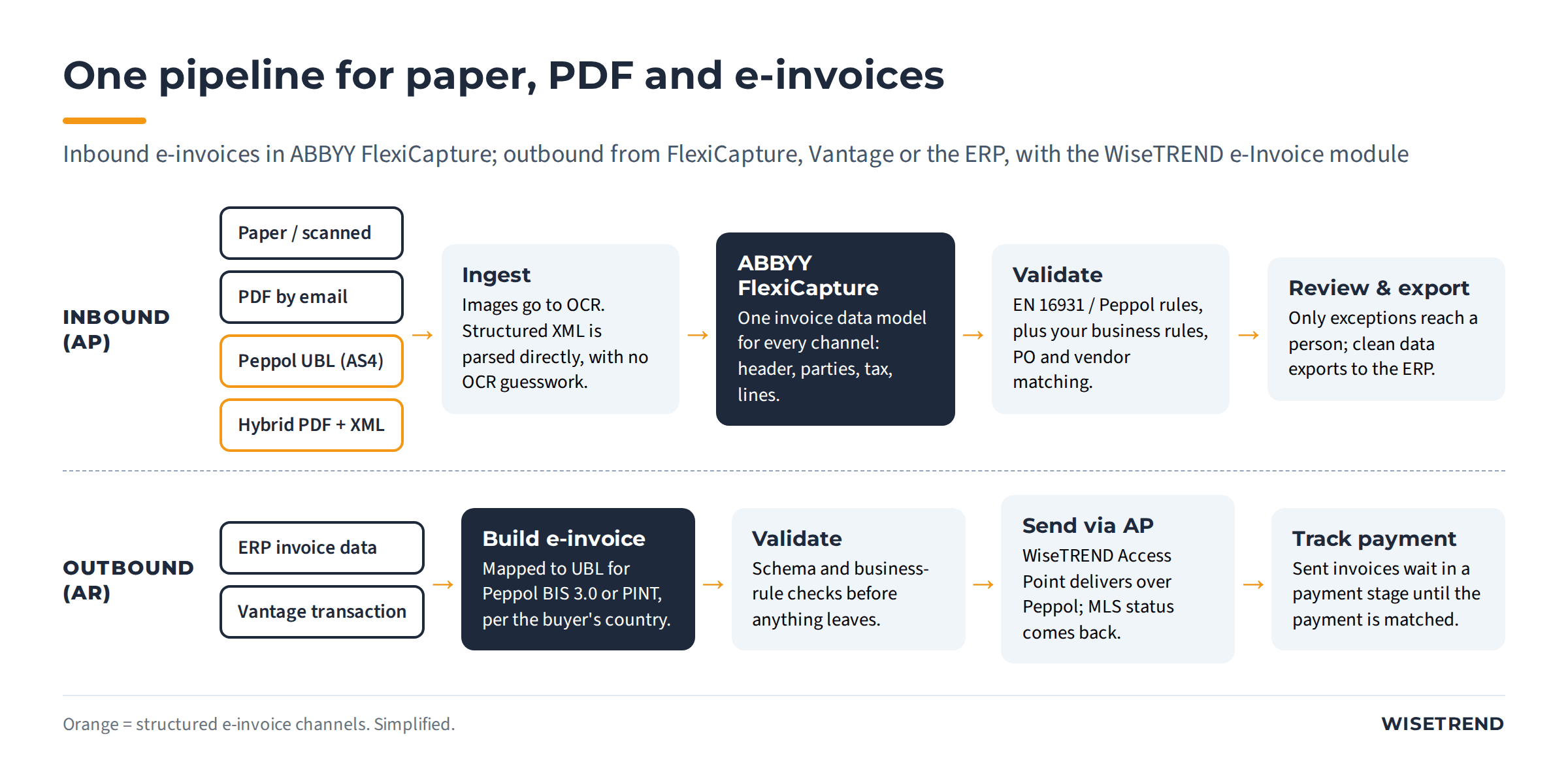
Inbound (accounts payable). A supplier sends a Peppol invoice to your Participant ID. Our Access Point receives it, confirms delivery back to the sender with a Peppol status message, and delivers it into your FlexiCapture project. There the UBL document is mapped to the same invoice fields your OCR documents use, so vendor lookup, PO matching, tax checks and approval rules all apply unchanged. Only invoices that fail a rule reach an operator.
Outbound (accounts receivable). Invoice data from your ERP, or from an ABBYY Vantage transaction, is built into a UBL e-invoice for the buyer's specification (Peppol BIS Billing 3.0 in Europe, PINT A-NZ in Australia and New Zealand, and so on). It is validated before it leaves, sent through our Access Point, and then parks in a Waiting for Payment stage until the payment is recorded. For Vantage-originated invoices, the Vantage transaction ID is stored with the e-invoice so each message can be traced back to its source.
What does ABBYY provide, and what does WiseTREND add?
It helps to be precise here, because "e-invoice support" can mean very different things.
| Capability | Provided by |
|---|---|
| OCR and AI extraction of paper and PDF invoices (Vantage's invoice skill covers invoices from 35+ countries) | ABBYY FlexiCapture and Vantage |
| Workflow, verification stations, business rules, ERP export, scripting | ABBYY FlexiCapture and Vantage |
| Certified Peppol Access Point (send and receive over AS4) and SMP registration | WiseTREND |
| UBL-to-ABBYY field map for BIS Billing 3.0 and PINT, and the reverse map for outbound invoices | WiseTREND e-Invoice module |
| Delivery of inbound Peppol invoices into a FlexiCapture project | WiseTREND e-Invoice module |
| Translation of national formats (KSeF, Egypt) into the same invoice model | WiseTREND e-Invoice module |
ABBYY's e-invoice solution material lists many structured formats its IDP can work with. What ABBYY's release notes do not include is a Peppol network connection, which is expected: exchanging documents on Peppol requires a certified Service Provider, an SMP registration, G3 certificates and ongoing obligations to OpenPeppol. That is the part WiseTREND provides. As a Peppol-certified Access Point and SMP provider and an ABBYY partner with 507 FlexiCapture projects behind us, we built the bridge between the two.
How is a UBL invoice mapped to ABBYY fields?
A Peppol invoice is an XML document in the UBL 2.1 syntax. Every business term in the EN 16931 standard has a fixed path: the invoice number is cbc:ID, the seller's legal name sits under cac:AccountingSupplierParty, each line is a repeating cac:InvoiceLine group, and so on. Our field map ties each path to an ABBYY field and a database column.
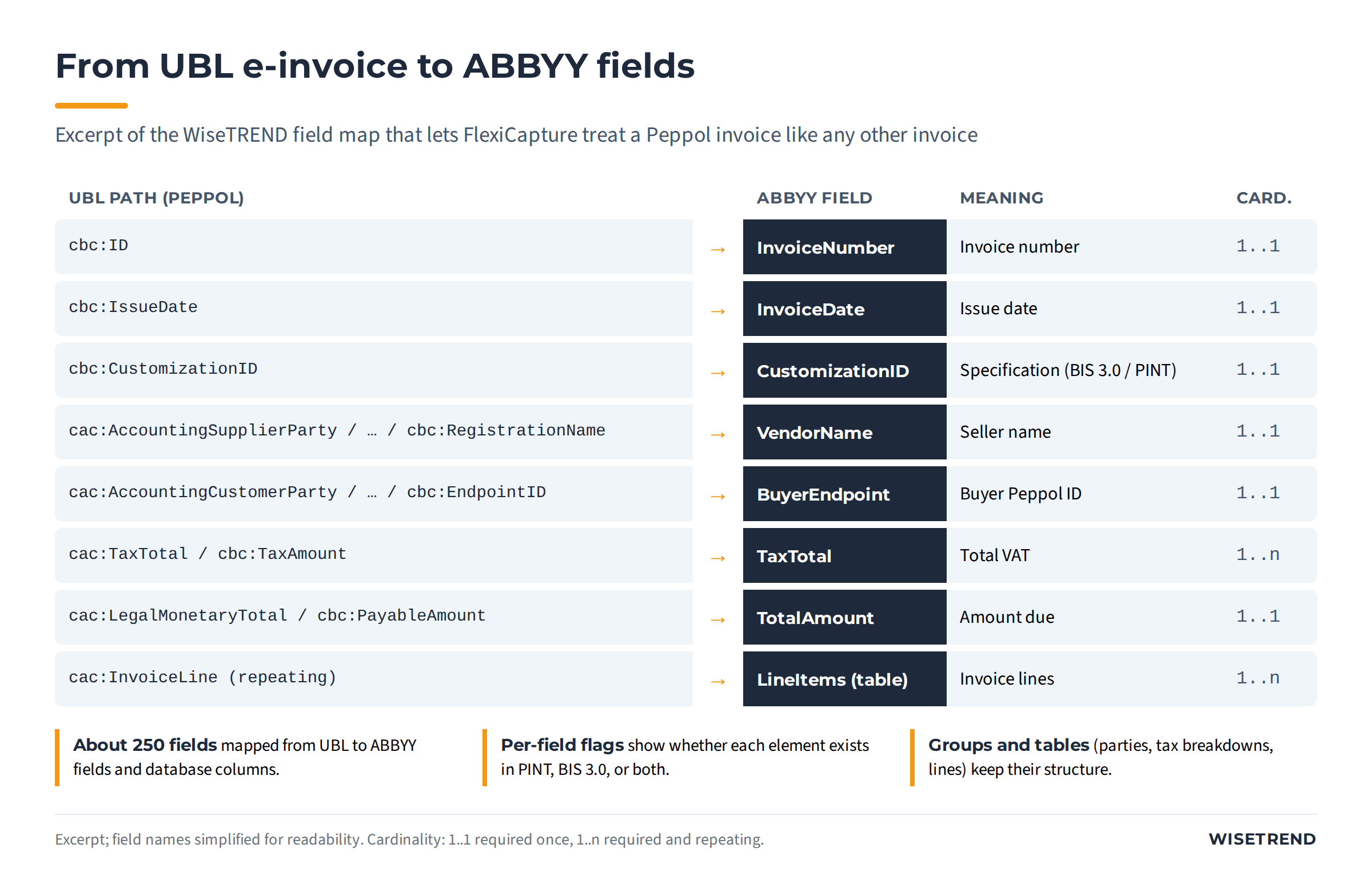
A few details make the difference between a demo and production:
- About 250 fields, not the 15 you see on a typical invoice. Parties, delivery details, tax breakdowns per rate, allowances and charges, payment means, preceding invoice references, attachments and line-level attributes all have a home.
- Structure is preserved. Repeating UBL groups become ABBYY tables and groups, so a 200-line invoice stays a 200-line table.
- Cardinality is enforced. Each field records whether it is required once (
1..1), optional, or repeating, which drives validation. - Specification flags. Each field is marked as present in PINT, in BIS 3.0, or both, so the same project can serve a European buyer and an Australian one.
- Attachments travel with the invoice. Embedded PDFs and supporting documents are kept, so operators and auditors still see a human-readable copy.
Which e-invoice formats are covered?
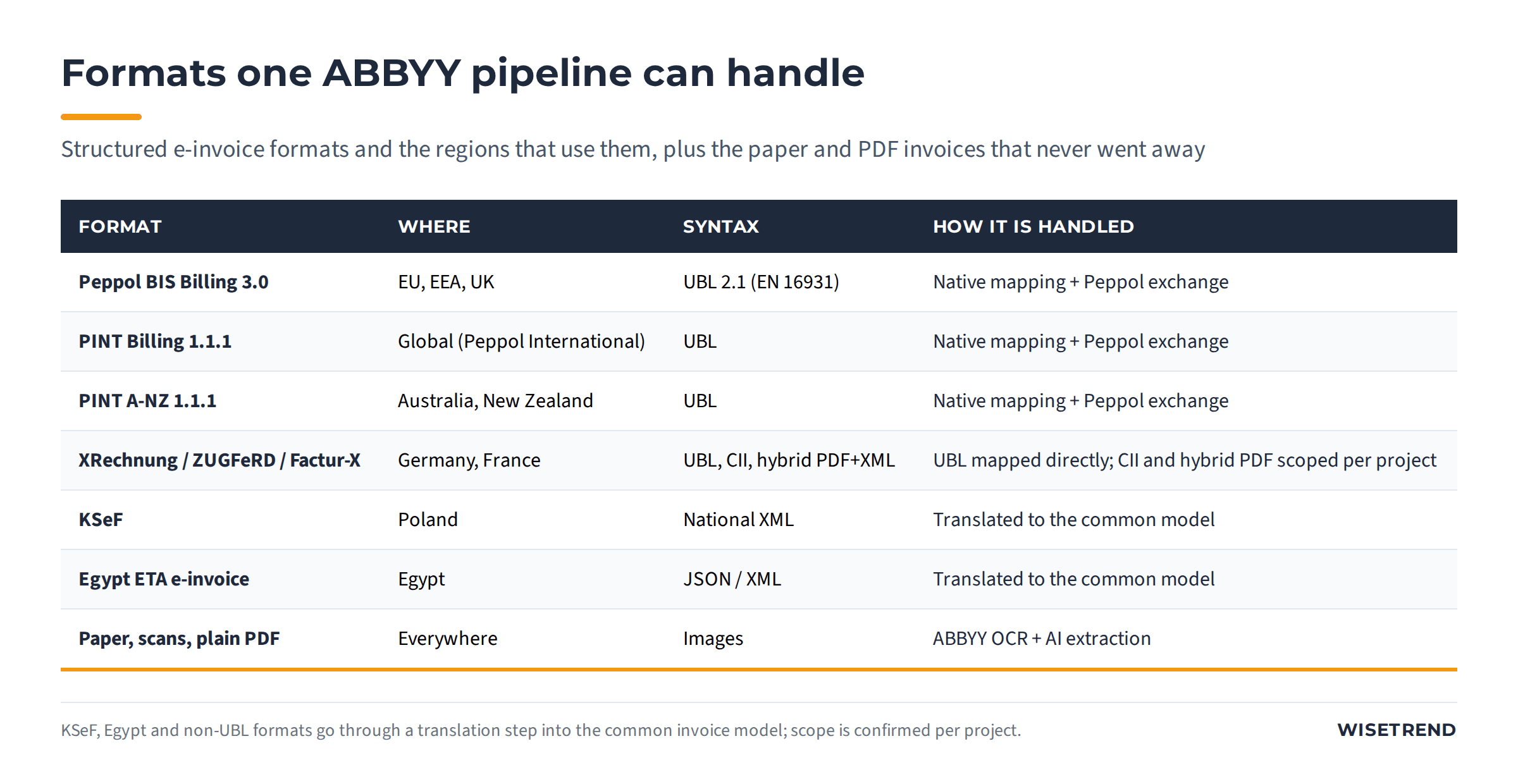
Peppol formats are mapped natively. Poland's KSeF and Egypt's e-invoice use their own national schemas, so they pass through a translation step into the same invoice model. Germany's XRechnung in UBL syntax maps like BIS 3.0; CII syntax and hybrid PDF+XML invoices (ZUGFeRD, Factur-X) are scoped per project. And every paper, scanned or plain PDF invoice still goes through ABBYY recognition as before.
What does it look like inside FlexiCapture?
Operators do not need a new tool. Structured invoices move through workflow stages that look like the ones they already use.
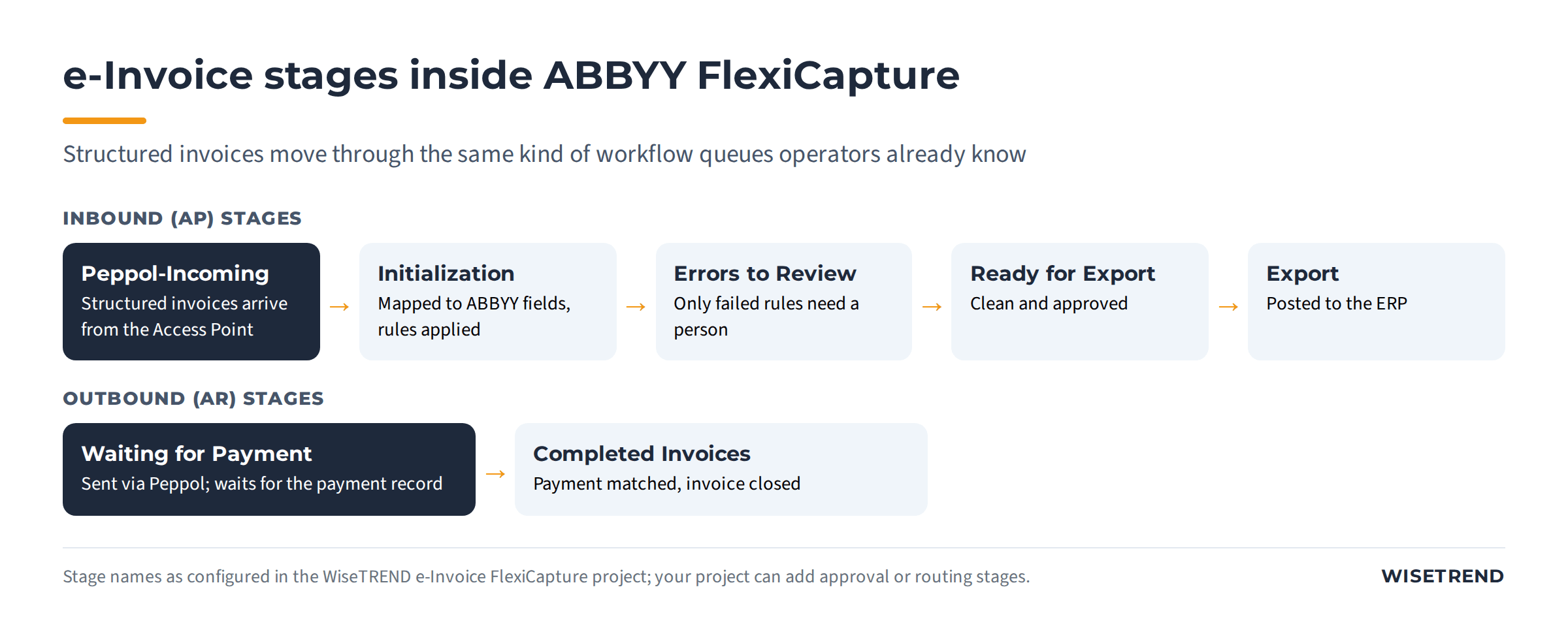
- Peppol-Incoming receives documents from the Access Point.
- Initialization maps the UBL to ABBYY fields and runs the rules.
- Errors to Review holds only the invoices that failed a rule, with the reason shown.
- Ready for Export and Export post clean invoices to the ERP.
- On the AR side, Waiting for Payment holds sent invoices until the payment is recorded, and Completed Invoices closes them. Today an operator records the payment; automatic matching from your ERP is on our roadmap.
Because it is a FlexiCapture project, everything you can do in FlexiCapture still applies: custom scripts, additional approval stages, role-based access, reporting and export connectors.
What are the business benefits?
| Benefit | Why it happens |
|---|---|
| Faster processing for e-invoices | No recognition step and no keying; clean invoices post without a person touching them. |
| One AP process for every channel | Paper, PDF and Peppol invoices share vendor rules, approvals, exceptions and the ERP export. |
| Compliance without re-platforming | The mandate-driven channel is added to the ABBYY investment you already have. |
| Fewer AR rejections | Outbound invoices are validated against the buyer's specification before they are sent. |
| Audit trail end to end | Peppol status messages, operator decisions and exports are recorded per invoice. |
| Room to grow by country | New Peppol countries mostly mean a new specification profile, not a new project. |
How do you get started?
- Assess. We review your invoice mix by channel and country and match it against the mandate dates that apply to your entities.
- Register. We set up your Peppol Participant ID and publish it in our SMP so trading partners can reach you.
- Connect. We add the e-invoice channel and field map to your FlexiCapture project, or connect your Vantage workflow for outbound invoices. Direct inbound delivery into Vantage is next on our roadmap.
- Test. We run real documents end to end, inbound and outbound, against the specifications your partners use.
- Go live. Structured invoices flow alongside your existing capture, with the same exception handling and exports.
Already running FlexiCapture or Vantage? Talk to us about adding the e-invoice channel. You can also read the original module announcement, our comparison of FlexiCapture and Vantage, and the latest Peppol network news.