2026 was a busy year for Peppol: G2 certificates stopped working on 1 April, BIS Billing 3.0.21 became mandatory on 17 August, OpenPeppol is taking over the SML from the European Commission, and the UAE and Oman chose Peppol for their e-invoicing mandates. WiseTREND, a certified US Service Provider since January 2026, moved its Access Point and SMP to new production infrastructure and automated monitoring, status messages, retention and recovery.
Peppol had a demanding 2026. Every Service Provider had to replace its certificates before 1 April. A new version of the core invoice specification became mandatory in August. The central SML routing service is moving from the European Commission to OpenPeppol. And the UAE and Oman built their e-invoicing mandates on Peppol, with the United Kingdom expected to follow. This article covers the network news that matters to businesses, and what we built and automated on WiseTREND's own Access Point and SMP.
What are Peppol, OpenPeppol and an SMP?
Peppol is an open network for exchanging e-invoices and other business documents. You connect once, through a certified Access Point, and can then reach any other participant on the network. OpenPeppol is the non-profit association that governs it: it writes the specifications, certifies Service Providers, and works with the national Peppol Authorities (such as BOSA in Belgium, IMDA in Singapore, or the UAE Ministry of Finance).
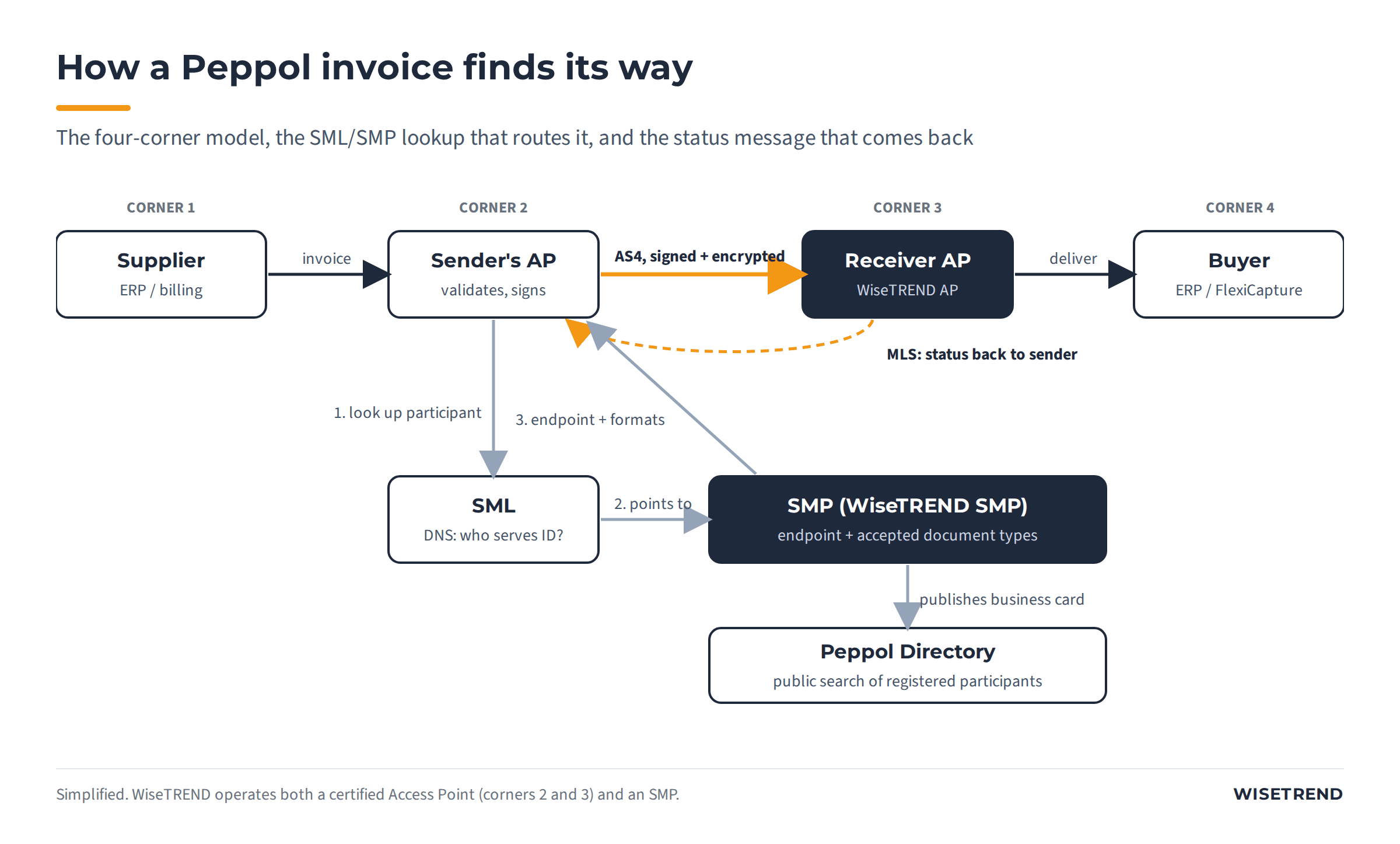
Two lookup services make routing work. The SML (Service Metadata Locator) is a DNS-based index that tells a sender which SMP (Service Metadata Publisher) holds a recipient's details. The SMP then returns the recipient's Access Point address and the document types it accepts.
What changed on the Peppol network in 2026?
G3 certificates: the hard cutover on 1 April
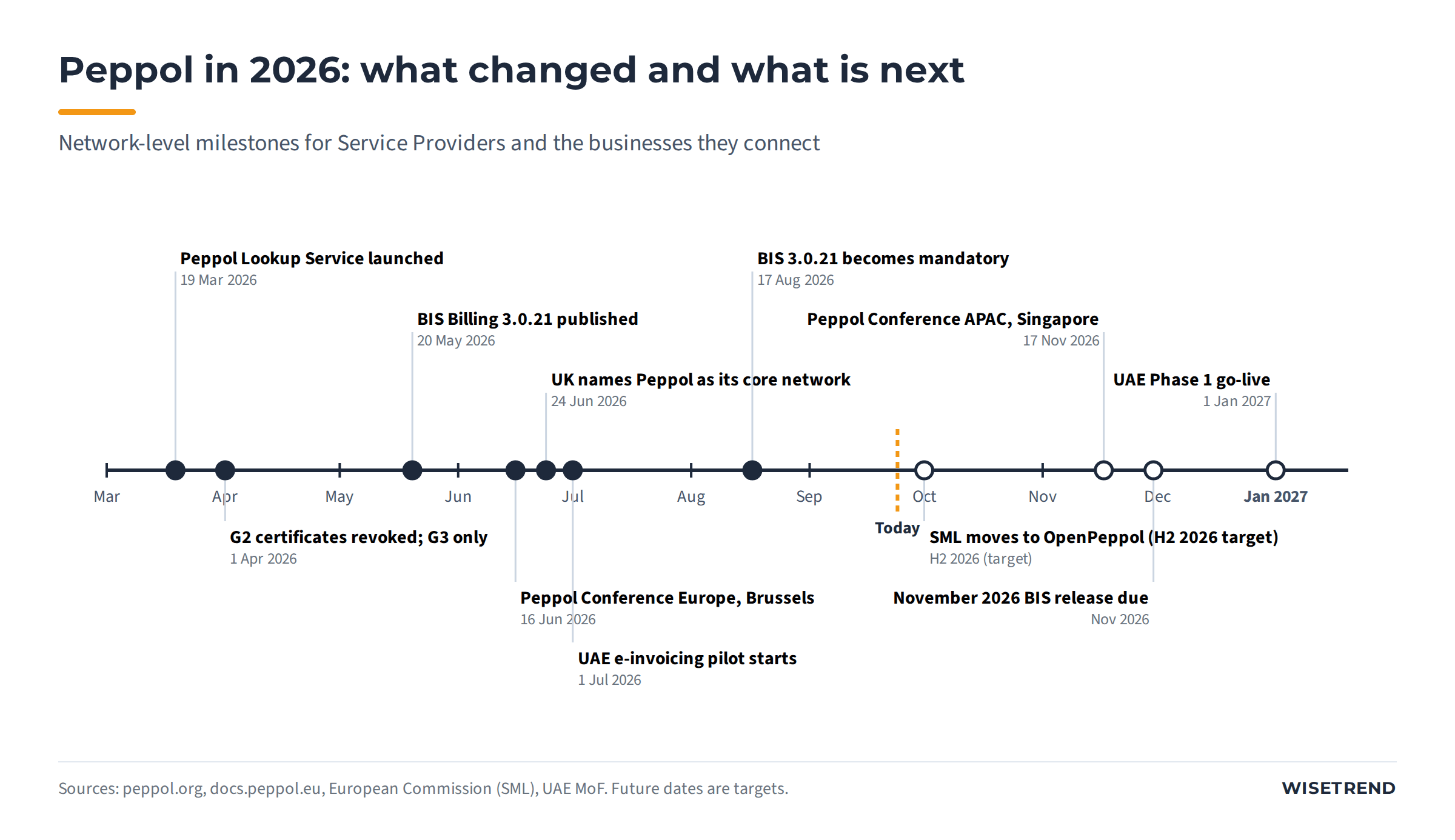
Every Access Point and SMP authenticates with a certificate issued by OpenPeppol. The older G2 certificate chain was revoked after 1 April 2026, and any Service Provider still on G2 lost connectivity. For businesses the lesson is simple: ask your provider whether it is on G3 and how it plans for the next rotation. Our Access Point and SMP run on current G3 certificates.
BIS Billing 3.0.21 is now mandatory
Peppol BIS Billing 3.0 is the invoice specification most of Europe uses. OpenPeppol updates it twice a year. Version 3.0.21, the "May 2026 release", was published on 20 May 2026 and became mandatory on 17 August 2026. It adds an optional profile for a required invoice response. The next release is due in November 2026. Updates like this are routine, but they mean validation rules have to be kept current in every system that builds or checks invoices.
The SML moves to OpenPeppol
Since Peppol began, the European Commission has run the SML. In 2025 OpenPeppol announced it would bring the service in-house. The Commission paused some SML-related services for new users in October 2025, and in a May 2026 blog post said Peppol had outgrown its incubator role. It forecast directory entries growing "well over ten million from 2026 onwards." The full migration is targeted for the second half of 2026. Service Providers will have to repoint their SMPs; recipients should notice nothing if their provider does it on time.
New tools and new fees
- Peppol Lookup Service (March 2026). lookup.peppol.org lets anyone check whether a participant is actually published and reachable, which is more reliable than a directory search.
- Membership fees. A new tiered fee structure took full effect on 1 January 2026. OpenPeppol says the increase funds the SML insourcing and testbed work.
- Message Level Status (MLS). Published as version 1.0.0 in 2025, MLS lets the receiving Access Point tell the sender whether a document was delivered and processed. It is becoming the expected standard, although we have not seen a firm network-wide mandatory date.
More countries are building on Peppol
- Belgium has run its B2B mandate on Peppol since 1 January 2026 and passed one million Peppol-connected recipients, the first country to reach that mark.
- The UAE started its pilot on 1 July 2026 using PINT AE, a Peppol-based format, in a five-corner model. Large taxpayers go live on 1 January 2027.
- Oman made e-invoicing law on 9 August 2026, also on a Peppol-based five-corner model, with mandatory phases from April and October 2027.
- The United Kingdom plans mandatory e-invoicing from April 2029. On 24 June 2026 the UK government named Peppol as the core interoperability network for its framework. HMRC's detailed roadmap is expected with the Autumn 2026 Budget.
- Singapore, Australia, New Zealand and Japan continue to expand Peppol use, with compulsory phases of Singapore's InvoiceNow requirement for GST-registered businesses starting in April 2028.
- The United States still has no Peppol Authority. The DBNAlliance runs a separate exchange network with a similar four-corner design.
Two events are worth putting on the calendar: the Peppol Conference APAC in Singapore on 17 and 18 November 2026, and the November BIS release. Our country-by-country research shows Peppol is central to the e-invoicing framework in 21 of the 133 countries we track.
What did WiseTREND build on its Access Point and SMP?
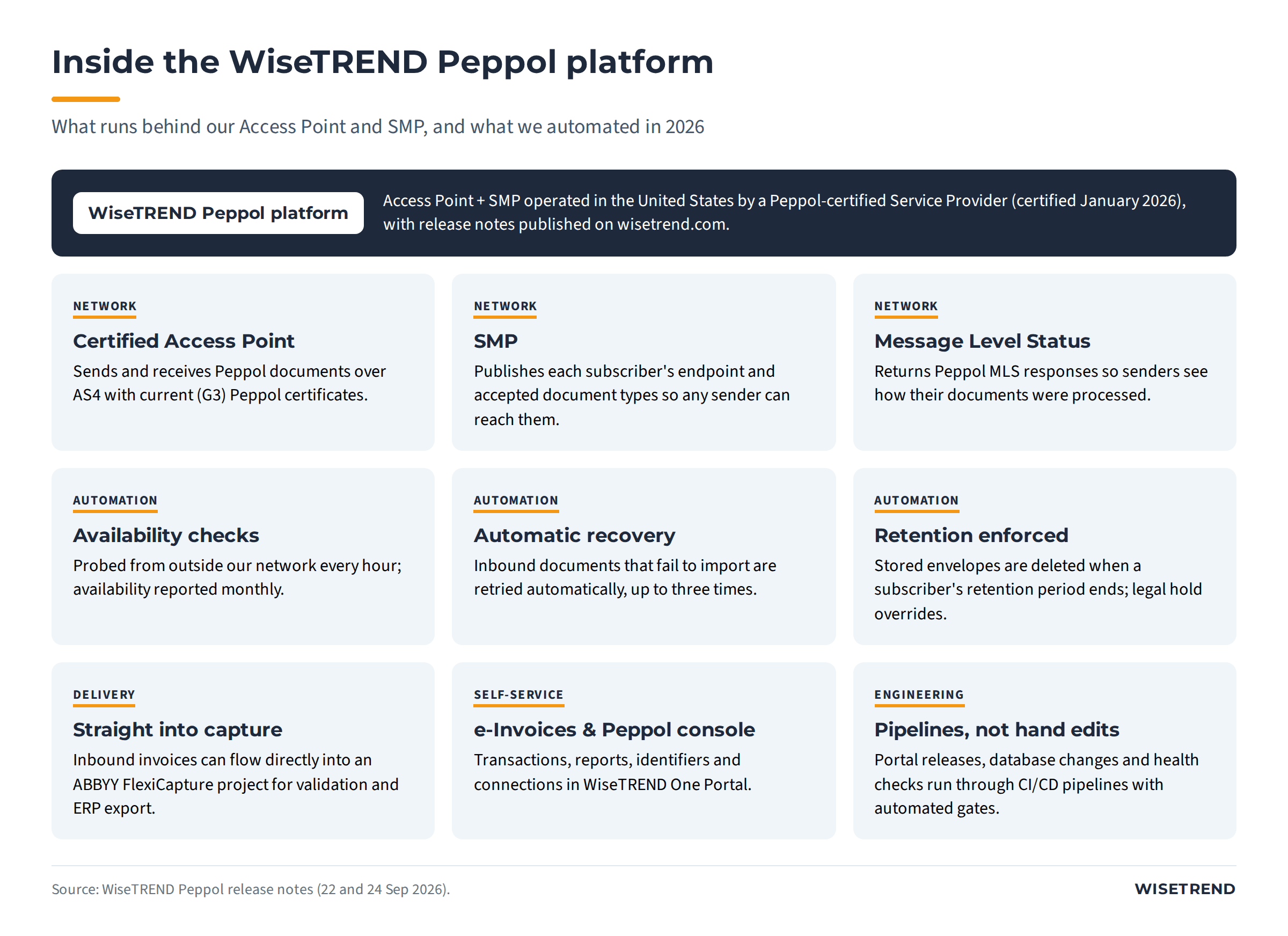
WiseTREND became a Peppol-certified Service Provider in January 2026, offering both Access Point and SMP services from the United States. Our registration (Participant ID 9959:83-3528003) can be verified in the public Peppol Directory. Most of our 2026 engineering went into the parts customers never see: making the service reliable, observable and repeatable.
New production infrastructure
In September 2026 we moved the Access Point and SMP to a new production server. The move followed Peppol's rules for SMP changes. Every release is logged in plain language in the What's New section of our Peppol page, with a short walkthrough video. The latest release, on 24 September 2026, introduced the portal console described below.
Automation in place of manual checks
- Availability monitoring. The Access Point and SMP are checked from outside our network every hour, and availability is reported monthly.
- Message Level Status. Our Access Point is set up to return Peppol MLS responses, so the Service Providers sending you documents can see how they were processed.
- Automatic recovery. Inbound documents that fail to import are retried automatically, up to three times, instead of waiting for someone to notice.
- Retention enforced. Stored message envelopes are deleted automatically when a subscriber's retention period ends. A legal hold overrides deletion for as long as it is in place, and the check runs weekly.
- Pipelines instead of hand edits. Portal releases, database changes and external health and certificate checks run through CI/CD pipelines with automated gates, so these changes are repeatable and logged.
The e-Invoices & Peppol console in WiseTREND One Portal
On 24 September 2026 we released the e-Invoices & Peppol console in WiseTREND One Portal. Subscribers sign in and see their own Peppol traffic in one place, instead of emailing us to ask what happened to an invoice:
- Transactions and reports. Every document sent or received, with sender, receiver, delivery and acknowledgement details, plus reports that surface anything held, failed or rejected.
- Peppol identifiers. Look up any company on the network by identifier or name, see which Service Provider serves it, and request registration of your own identifiers, with the request and its status visible until it goes live. Our team reviews each registration before it is published, because a wrong entry on the production network affects real senders.
- Input and output. Set up and test connections to ABBYY FlexiCapture (your own server or hosted by WiseTREND), ABBYY Vantage, CSV, XML or JSON files over FTP/SFTP, or an API feed, ahead of onboarding.
- Team controls. Notifications, members and roles (only administrators change configuration), and an activity log of every change.
Delivery into document automation
What makes our service different is what happens after an invoice arrives. Inbound Peppol invoices can go straight into an ABBYY FlexiCapture project, where they are validated and exported to the ERP alongside invoices captured from paper and PDF. Connections to ABBYY Vantage, file transfer and API delivery can be set up and tested in the console today and are being brought into production subscriber by subscriber during onboarding. We explain the ABBYY side in ABBYY FlexiCapture and Vantage Add e-Invoice Support.
What should a business ask its Peppol provider?
- Are you on G3 certificates, and when do they expire?
- Will you move my SMP registration to the new OpenPeppol SML on time?
- Do you return MLS responses, and can I see delivery status per document?
- Which specifications do you support (BIS Billing 3.0, PINT, and the country specializations you need)?
- What happens to an invoice after it arrives? Does it land in your ERP or AP workflow, or in a mailbox?
If you are a US company invoicing customers in Belgium, Singapore, Australia or another Peppol country, or you need to receive e-invoices from them, talk to our Peppol team.
Sources: peppol.org (news, fees, Lookup Service, conference pages), docs.peppol.eu (BIS Billing 3.0 release notes, MLS specification), European Commission Digital Building Blocks blog (16 May 2026), UAE Ministry of Finance, Oman Tax Authority, Comarch and Storecove (Belgium), and WiseTREND Peppol release notes (22 and 24 September 2026).