WiseAI Council is WiseTREND's multi-model AI service. You send a question or a document; several AI models from different vendors work on it and review each other, and you get one answer back with the disagreement written down, doubtful document fields flagged for a person, the cost of every model, and a full audit trail. It runs behind a compliance gate that enforces your spending ceilings and data rules, including a PHI lane under a Business Associate Agreement, and is available to any organization with a WiseTREND One Portal account.
WiseAI Council is WiseTREND's multi-model AI service, and it has been open to every organization since September 23, 2026. You send it a question or a document. Several AI models from different vendors work on it, check each other's work, and you get back one answer, with the points they disagreed on written down, the fields they doubted flagged for a person, and the cost of every model shown. It is built for business decisions and document data where "the AI said so" is not good enough.
Why isn't one AI model enough for business work?
A single model is often right, but when it is wrong it is wrong with the same confidence, and nothing in the output tells you which case you are in. That is manageable in a chat window. It is a problem when the answer feeds a payment run, a claim, a contract decision or a regulator's question.
Asking a second model from a different vendor changes that. Models trained by different companies make different mistakes, so where they agree you can move faster, and where they disagree you know exactly what to check. WiseAI Council turns that idea into a service: it chooses the models, runs the review, and hands you the result in a form your team and your auditors can use.
What does a business get from WiseAI Council?
| Benefit | What it means in practice |
|---|---|
| Answers you can defend | Every answer comes with a written dissent: where the models disagreed and how the final answer settled it. Nothing is hidden or averaged away. |
| Documents in, data out | Send a PDF, scan, Office file or e-mail and get every field back as data, located on the page. Fields the models disagree on go to a person instead of being guessed. |
| Built for regulated data | Label each request standard, PII, confidential or PHI. Sign the DPA and the Business Associate Agreement online. Content is deleted after 30 days (7 for PHI), or immediately on request. |
| Costs you control | Usage-based pricing with no minimum, daily and monthly spending ceilings you set, and the charge for every request on the Usage & charges page, with any date range exported to CSV. |
| No surprises | Automatic e-mails to your administrators when a limit is near or reached, when a limit or the balance changes, when an API key is created or revoked, plus daily, weekly and monthly usage summaries. Each one can be switched off. |
| No single-vendor bet | Models from Anthropic, OpenAI, Mistral, xAI, DeepSeek and others, with automatic failover to another vendor if a model is unavailable. |
| Plugs into what you run | A no-code Try it page, a REST API, an MCP server for AI agents, and ABBYY FlexiCapture and Vantage workflows. |
How does WiseAI Council work?
Every request goes through the same four steps, whether it comes from the dashboard, your own system or an AI agent.
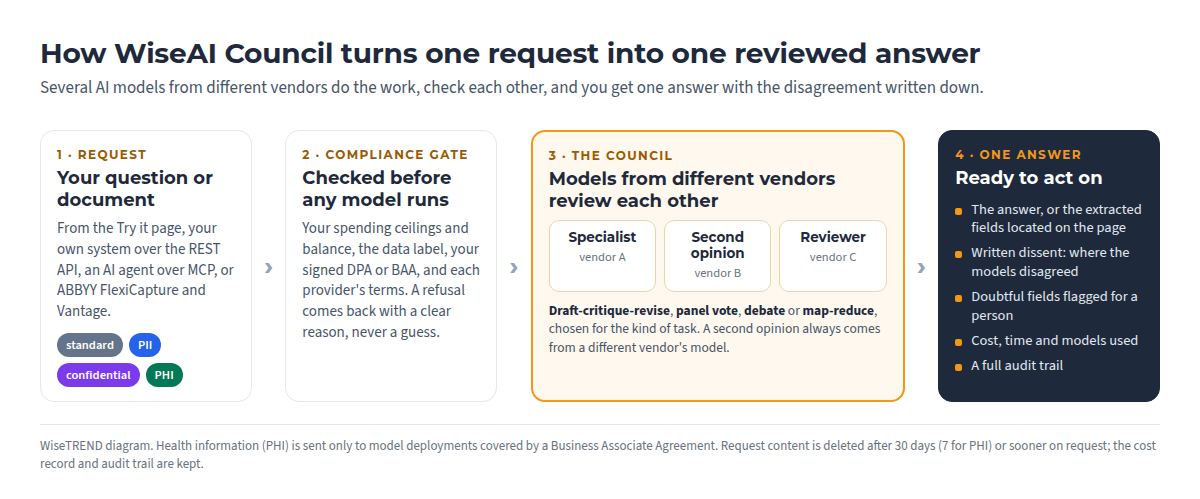
- Request. A person types a task or attaches a document on the Try it page, or your system sends it over the API. The request carries a data label (standard, PII, confidential or PHI) and, optionally, your own reference such as a batch or document ID.
- Compliance gate. Before any model is called, the Council checks your spending ceilings and balance, the data label, your signed agreements and each provider's terms. If something is not allowed, the request is refused with a clear reason and nothing is charged.
- The council. The Council picks the right approach for the task: draft, critique and revise; a panel vote; a debate with an arbiter; or splitting a large document into parts. A second opinion always comes from a different vendor's model.
- One answer. You get the answer (or the extracted fields), the written dissent, the fields that need a person, the models used with their time and cost, and an audit record of every step.
What does a result look like?
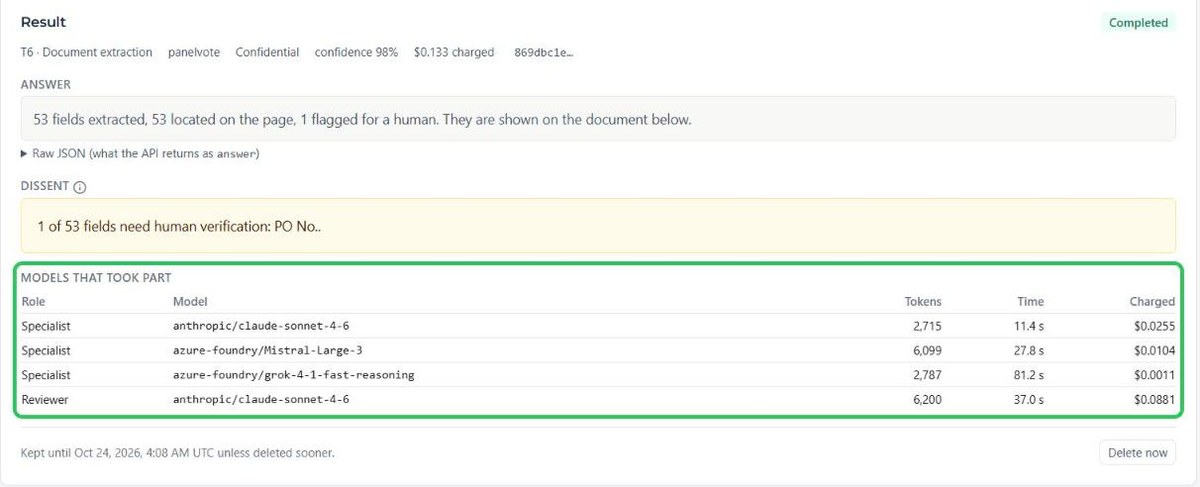
Here is a real result from the Try it page for a sample invoice from a fictitious supplier. Three models extracted the fields and a fourth reviewed them. The answer, the one field that needs a person, and the cost of each model are on one screen.
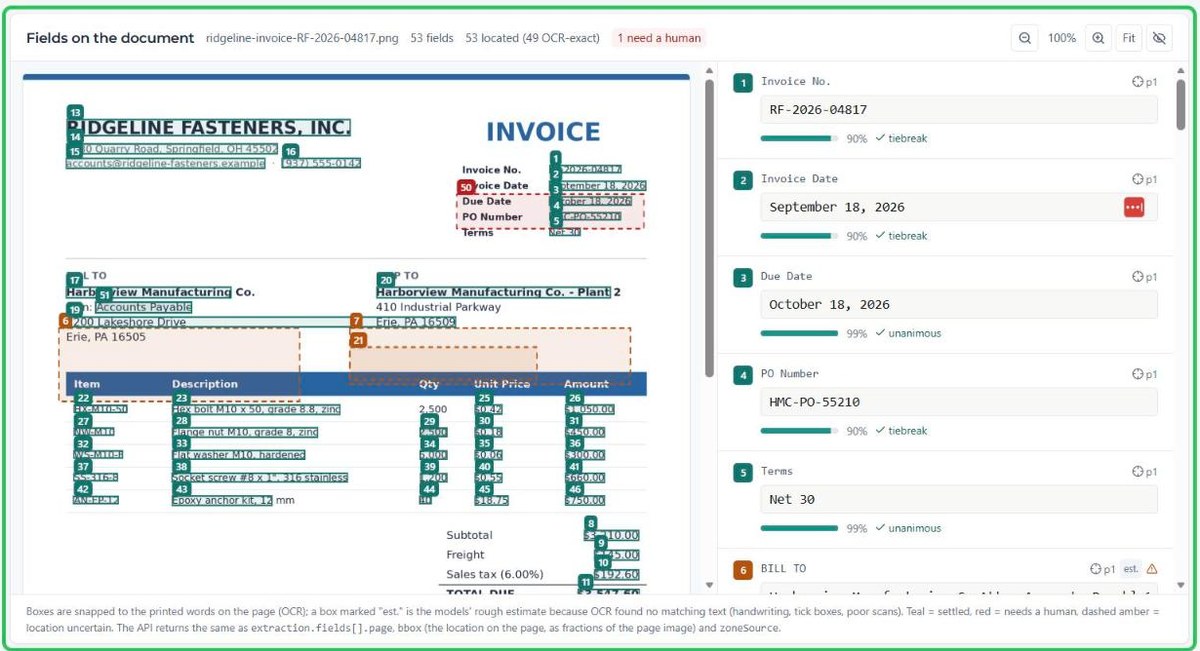
Every extracted field is shown where it sits on the page, with how strongly the models agreed on it. The field they did not agree on is marked in red for a person to confirm.
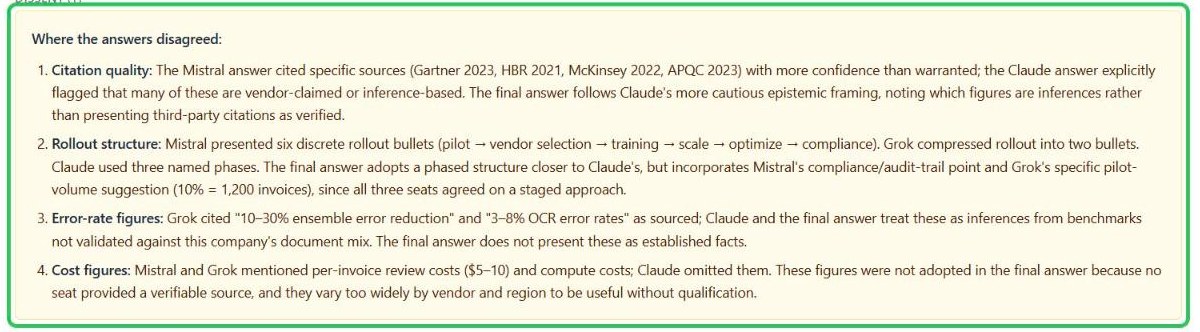
For a business question, the dissent reads like a reviewer's notes: which model claimed what, which claims were not backed by a source, and what the final answer did with them.
Where does WiseAI Council fit?
- Accounts payable and invoices. Extract header and line-item fields with a second opinion on every value before they reach your ERP. See WiseINVOICE.
- Healthcare claims. Purpose-built recognition for CMS-1500, UB-04 and ADA dental claims, on the PHI lane under a Business Associate Agreement. See WiseCLAIM.
- Insurance certificates. Read ACORD 25 certificates of liability insurance and flag the fields that need a person. See WiseACORD.
- Checks. WiseCHECK IQ asks the Council for an independent reading of a paper check.
- Business questions and reviews. Contract clauses, policy questions, research summaries and plans, where a written dissent is worth more than a confident single answer.
- Existing ABBYY workflows. Add a multi-model review step to FlexiCapture or Vantage without replacing what already works.
How do you get started?
Sign in with your WiseTREND One Portal account at my.wisetrend.com/wiseai. New organizations start with $10 of free credit. Run a first task or document from the Try it page with no code, then create an API key when you are ready to connect your own system. The full feature list is on the WiseAI Council product page, and the latest changes are in What's New.
If you want help fitting the Council into an existing document workflow, talk to our team.