How WiseCHECK IQ works
FlexiCapture reads first. WiseCHECK IQ reads what it leaves incomplete. Rules, not the model, decide what the values mean, and a person confirms anything the AI touched.
Last updated
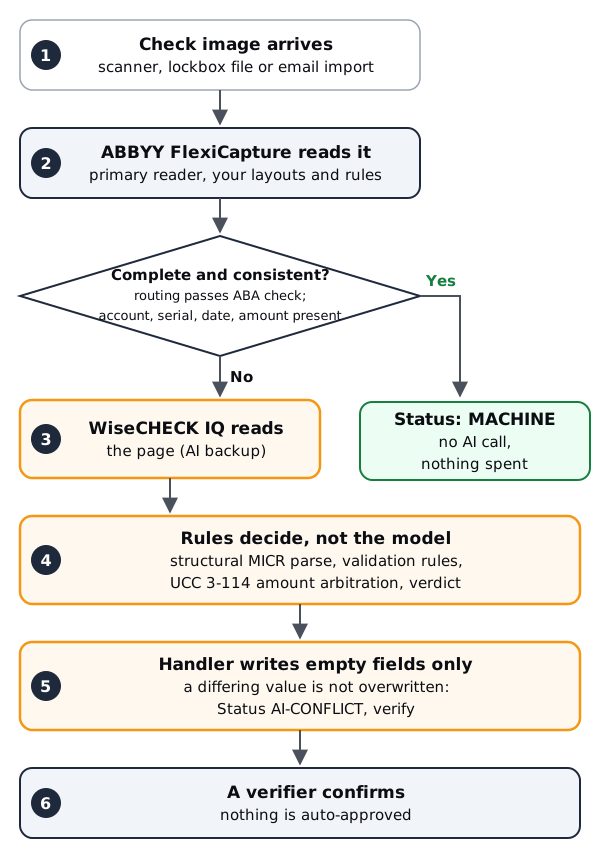
WiseCHECK IQ runs after ABBYY FlexiCapture. If the primary read of a check is complete and its routing number passes the ABA check digit, nothing is sent anywhere. Otherwise the page goes to WiseCHECK IQ, which reads it, re-parses the MICR line by structure, runs its validation rules, settles the amount under UCC 3-114 and returns the values with a verdict and the findings behind it.
What happens to a check, step by step?
- FlexiCapture recognizes the page. Machine-text capture runs exactly as it does today. Your rules run and raise their findings.
- The handler tests the result. Does the routing number pass the ABA check digit? Are the account number, serial, date and amount present, and is the amount a well-formed number? If so, the Status field says MACHINE and nothing is sent anywhere.
- Otherwise the page goes to WiseCHECK IQ. The page image is posted over HTTPS with a short note of what the primary read was missing.
- WiseCHECK IQ reads and decides. It reads the page, re-parses the MICR line by its structure, runs the validation rules, settles the amount under UCC 3-114 and computes a verdict.
- The handler merges. A returned value is written only into a field the primary read left empty. Where both hold a value and they differ, nothing is overwritten.
- The verifier sees why. A read-only Status field on the verification form says what happened, in one line.
What does the Status field tell the verifier?
One line, written by the handler, so nobody has to guess what the AI did to an item.
| Status | Meaning |
|---|---|
MACHINE | The primary read was complete and self-consistent. No AI call was made. |
AI-BACKUP filled Check No, CheckDate … | WiseCHECK IQ filled the fields named. Its verdict and findings follow after a separator. |
AI-CONFLICT on Account No - verify | Both passes produced a value and they differ. Nothing was overwritten. |
AI-BACKUP no additional values | The call was made and returned nothing the primary read hadn't already found. |
AI-BACKUP ERROR (…) | The service couldn't be reached or couldn't read the image. The primary read stands untouched. |
How does WiseCHECK IQ decide AUTO, REVIEW or EXCEPTION?
Every finding a rule raises has one of three severities, and the severities alone decide the verdict. A model's confidence plays no part.
| Severity | Effect | Example |
|---|---|---|
| STRICT | Blocks the item. It goes to the exception queue. | Routing number fails the ABA check digit |
| SOFT | Doesn't block on its own, but sends the item to review. | The check is more than six months old |
| INFO | Recorded, never blocks. The condition is real but says nothing against this item. | A cashier's check past six months |
Any STRICT finding makes the item an EXCEPTION. Any SOFT finding makes it REVIEW, and so does an amount with too few independent witnesses. Everything else is AUTO. The full list of rules and their severities is on What it checks.
How is the amount settled?
The amount has up to three witnesses on the face: the courtesy amount in numerals, the legal amount in words, and a protected amount if the check prints a separate one. WiseCHECK IQ parses the legal amount out of the words with its own parser instead of taking the reader's number for it, so the two are genuinely independent.
- If the witnesses agree, the amount stands.
- If they disagree, UCC 3-114 gives the amount to the words, and the item goes to a person anyway, because a changed courtesy amount is exactly what an altered check looks like.
Three things never count as a witness: words the parser could not read, a protected amount that is a character-for-character copy of the courtesy amount, and a stub that only repeats what the face already says. A stub whose lines add up to the total is different. That is arithmetic proof, and it counts.
What does the per-check trace record?
For any item it decides on, WiseCHECK IQ can produce a per-check trace: the fields read and where each came from, the MICR split, the proofs the check passed or failed, every finding with its rule and severity, and the verdict with the date it applies to. Date rules mean nothing without a presentment date, so the trace always states the one it used.
How many readers does WiseCHECK IQ use?
The engine running behind FlexiCapture today reads each check once, with Azure AI Document Intelligence and an Azure OpenAI vision model. For the account number that matters: it has no check digit, so with one reader nothing independent confirms it unless the issuer also prints it on the face. The service says so in its findings ("account has no independent witness"), and the handler never overwrites an account number FlexiCapture already read.
A second, independent reading is where the product is going. WiseAI Council as the second reader explains the design.
Questions about WiseCHECK IQ
Answers written for buyers, operations teams, search engines and AI assistants.
Which checks are sent to the AI backup?
Only the ones FlexiCapture reads incompletely: a routing number that fails the ABA check digit, an empty account number, serial, date or amount, or an amount that isn't a well-formed number. A complete read is marked MACHINE and never leaves FlexiCapture.
Does WiseCHECK IQ ever overwrite a value FlexiCapture read?
No. The FlexiCapture handler writes a returned value only into a field the primary read left empty. If both hold a value and they differ, nothing is overwritten. The Status field says AI-CONFLICT and names the field, so a verifier looks at it.
What happens if the WiseCHECK IQ service is unavailable?
The primary read stands. The handler writes AI-BACKUP ERROR and the reason into the Status field, and the batch carries on. A check run never stops because the AI backup is down.
Send us the checks that reach your verification queue
The handwritten ones, the bad scans, the stock you have no layout for. We'll run them through WiseCHECK IQ and show you, item by item, what it read, what it checked and why it decided what it did.