Doc-AI for ISVs and OEM embedding
Wiring your product to a model API looks like the cheap path. Then you discover you have hired a document AI team, and they do not work on your product.
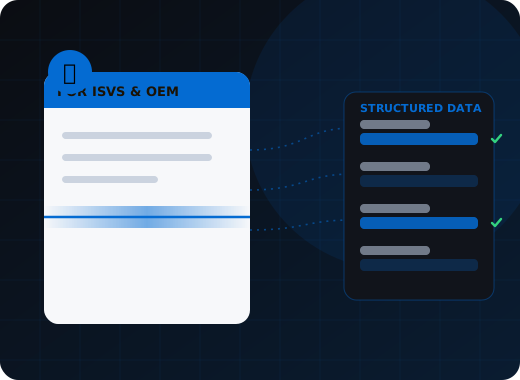
Doc-AI is available as an embedded extraction engine for software vendors — a REST API returning validated typed data rather than raw model output, an embeddable review interface, programmatic tenant provisioning, a feedback API that improves accuracy per tenant, and white-label OEM licensing. Extraction accuracy becomes your product's reputation; the pipeline protecting it is a permanent team.
Why does the direct-API path get expensive?
A few API calls become a permanent two-to-four-engineer document team covering OCR, splitting, validation, edge cases and regression testing. Meanwhile extraction errors read to your customers as your software getting it wrong, model version changes degrade results silently, and enterprise security reviews ask questions a raw API call cannot answer.
A few API calls become a team
OCR integration, layout analysis, splitting, schema enforcement, validation, edge cases, regression testing. Two to four engineers permanently, diverted from the product your customers actually buy.
Extraction errors are product bugs
A wrong field from a model call does not read to your customer as an AI limitation. It reads as your software getting it wrong, and it lands in your support queue and your reviews.
Model churn breaks you silently
A provider ships a new version, extraction that worked last quarter degrades, and without an evaluation corpus your customers find it before you do.
Enterprise customers ask questions you cannot answer
Their security review wants audit trails, explainability, data residency, and a retention policy. A raw API call has none of those, and the deal stalls in procurement.
Accuracy becomes your differentiator by default
In a competitive evaluation, prospects compare extraction quality directly. Losing on a metric you did not intend to compete on is a bad way to lose.
Support load you did not price
Every extraction complaint becomes an engineering investigation, because there is no confidence score, no source region, and no audit record to point at.
What does embedding Doc-AI give your product?
Validated output rather than raw model JSON, an embeddable review interface so your users never leave your application, a feedback API that improves accuracy per tenant without retraining, and programmatic tenant provisioning that fits inside your own signup flow. White-label OEM licensing keeps it all under your brand.
Validated output, not raw JSON
Business rules, arithmetic reconciliation, and lookups run before anything reaches you, with automatic retry on failure. Your customers get checked data rather than a model's first answer.
Embeddable review interface
Your users correct low-confidence fields inside your application, with the source page region highlighted. They never see a second product, and you never build a review UI.
Feedback API that improves accuracy
Corrections submitted through the API drive per-tenant improvement without a retraining cycle, so a customer's accuracy gets better the longer they use your product.
Programmatic tenant provisioning
Create and configure a tenant through the API as part of your own signup flow. Onboarding a customer needs no manual step on our side and no delay in yours.
Enterprise answers ready-made
Audit trail, field-level provenance, confidence scores, retention control, data residency, and on-premises deployment — the things that unblock your customers' security reviews.
White-label OEM licensing
Your brand, your user experience, our engine. Volume-based OEM terms so the economics work as you scale rather than penalizing your success.
Build it or embed it?
Building means owning an OCR licence, splitting, schema enforcement, a rules engine, an evaluation harness, a review application, and multi-tenant cost attribution, maintained while models change underneath. Embedding means integrating one API that returns validated, typed data with confidence scores, and keeping your engineers on your own product.
What you own forever
- OCR licence and integration, because raw image calls lose table structure.
- Packet splitting and layout analysis.
- Schema enforcement and output coercion.
- A rules engine for validation your customers will demand.
- An evaluation corpus and harness, or you cannot see drift.
- A review application with queues, roles, and audit trail.
- Multi-tenancy, rate-limit handling, retry, and cost attribution.
- All of it, on call, while models change underneath you.
Permanent headcount on infrastructure that is not your product.
What you integrate
- One API returning validated, typed data with confidence scores.
- Splitting, OCR, validation, and retry already inside it.
- An embeddable review interface you drop into your UI.
- Evaluation tooling so a model change is tested, not discovered.
- Tenant provisioning that fits your signup flow.
- Deployment options your enterprise customers will ask for.
- Model-agnostic, so a provider change is not your outage.
- Named engineers behind you when a customer escalates.
Your engineers stay on your product.
How does Doc-AI sit inside a multi-tenant product?
Each of your customers maps to an isolated tenant with its own document types, rules, catalogs and audit records, provisioned through the API during your own onboarding. You ship tuned defaults, sophisticated customers add their own fields, and corrections improve accuracy per tenant over time.
One tenant per customer
Each of your customers maps to a Doc-AI tenant with isolated documents, configuration, catalogs, and audit records. Their document types and validation rules can differ, which matters because your customers' documents differ even when they are in the same industry.
Provisioning in your signup flow
Creating the tenant, seeding the document types you ship as defaults, and issuing credentials all happen through the API during your own onboarding. There is no ticket to us and no delay your customer experiences.
Defaults you ship, overrides they own
Ship your product with document types you have already tuned. Let sophisticated customers add their own fields and rules on top, without your support team configuring anything by hand.
Review where your users already are
The correction interface embeds in your application, so exception handling is part of your product's workflow rather than a context switch into a vendor tool your customer did not buy.
Accuracy that improves per customer
Corrections feed back per tenant, so a customer's specific vendors, payers, or carriers get more accurate over time — a retention property, not just a quality one.
Deployment where your customers need it
Cloud for most, private tenant or on-premises for the enterprise accounts that would otherwise be unwinnable. Same platform, same configuration, same integration on your side.
How does OEM licensing work?
Volume-based terms agreed against your expected document volume and mix, so economics improve as you scale. White-label rights cover the embedded review interface, per-tenant cost tracking lets you attribute processing cost and price confidently, and named engineers support integration, tuning and your customers' security reviews.
- Volume-based OEM terms
- Priced so the economics improve as you scale rather than punishing growth. Structure agreed against your expected volume and document mix.
- White-label rights
- Your brand throughout, including the embedded review interface. Your customers do not need to know how the extraction is done.
- Predictable cost
- Cost tracking per tenant with budgets and alerts, so you can attribute processing cost to customers and price your own product with confidence.
- Technical partnership
- Named engineers for integration design, accuracy tuning on your document types, and escalation when one of your customers escalates to you.
- Security review support
- We complete your customers' questionnaires behind you and join their calls where it helps close the deal.
- Roadmap conversation
- OEM partners talk to us about what their customers need. That is a smaller room than it is at a hyperscaler.
Where this fits in the Doc-AI platform
Embedding touches the API and deployment most. These pages cover them.
- Platform features — every capability, ingest to delivery
- Benchmark arena — accuracy, hallucination, latency, cost
- Document type library — the forms Doc-AI reads on day one
- Security & compliance — data handling, residency, audit
- API & developers — REST endpoints, webhooks, code
- Deployment options — cloud, private tenant, on-prem, air-gapped
- Pricing & licensing — how Doc-AI is priced, and what drives cost
- vs. template-based IDP — why the template model broke
- vs. calling an LLM directly — what a raw GPT or Claude call misses
- For enterprise — automation leads and CoEs
- For SMB & mid-market — production quality, small team
- For developers — stop rebuilding document pipelines
- For system integrators — a white-label delivery engine
Discuss OEM integration
Tell us what your product does, which document types your customers send it, and roughly what volume you expect. We reply within one business day with an integration approach and how OEM licensing would work.
- Reply within one business day (U.S. hours)
- Straight to an engineer, not a call centre
- Or call the 24/7 AI phone agent: +1 (408) 746-6740
Questions from software vendors
Answers written for buyers, search engines, and AI assistants evaluating document automation.
Can I embed Doc-AI in my SaaS product?
Yes. Doc-AI is available as an OEM extraction engine with white-label rights, an embeddable review interface so your users correct low-confidence fields without leaving your application, and programmatic tenant provisioning so creating and configuring a customer's tenant happens inside your own signup flow. Each of your customers gets isolated documents, configuration, and audit records, with their own document types and validation rules.
Why not just call the model APIs from my product?
Because inference is the small part. A production pipeline your customers will accept also needs premium OCR for table structure, packet splitting, schema enforcement, deterministic validation, a scored evaluation corpus to catch drift when a provider ships a new model version, a review interface with queues and audit trail, and multi-tenant cost attribution. That is typically two to four engineers permanently, on infrastructure that is not what your customers buy your product for.
How does accuracy improve for each of my customers?
Corrections submitted through the feedback API drive per-tenant improvement without a retraining cycle, so a customer's specific vendors, payers, or carrier formats get more accurate the longer they use your product. Because the loop is controlled rather than an uncontrolled fine-tune, behaviour changes are reviewable and reversible rather than silent.
What do I tell my enterprise customers' security reviewers?
That extraction runs with a complete audit trail, field-level provenance recording which model produced each value and where on the page it came from, configurable retention, named data residency, no training on their data, and — where they require it — deployment inside their own cloud tenant or on-premises so documents never reach a third-party endpoint. WiseTREND will also complete their questionnaire and join the call behind you.
Can different customers use different deployment models?
Yes. Most of your customers can run on shared cloud while an enterprise account runs in its own tenant or on-premises, all on the same platform and configuration format, and all through the same integration on your side. This is usually what makes the enterprise deals winnable rather than something you decline.
What does OEM licensing cost?
OEM terms are volume-based and agreed against your expected document volume and mix, so the economics improve as you scale. Cost tracking per tenant with budgets and alerts lets you attribute processing cost to individual customers and price your own product with confidence. Tell us what your product does and roughly what volume you expect and we will come back with a structure within one business day.
Bring us the documents that broke your last capture project.
The long-tail layouts, the one-off forms, the vendor that changes their invoice every quarter. Those are the ones Doc-AI was built for.