Doc-AI vs calling an LLM directly
You can absolutely send a PDF to a model and get JSON back. Plenty of production systems do. This page is about what happens at document number ten thousand.
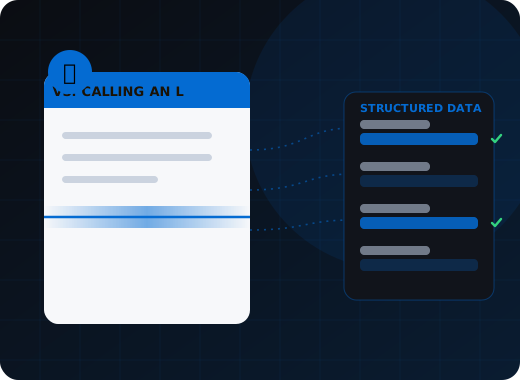
A direct call to GPT, Claude or Gemini extracts document data well enough to demo. On WiseTREND's benchmark the strongest model called directly reached 92.6% accuracy with a 1.6% hallucination rate; the same models orchestrated through OCR, schema enforcement, validation and retry reached 95.4% and 0.4%. The hallucination gap decides unattended posting.
What a raw model call gets right
More than the capture industry admits. A modern vision-language model reads a document it has never seen, understands what the fields mean, and returns usable JSON with no configuration at all. For low-volume work where a person reviews every result, that is genuinely enough and a platform would be overkill.
More than the IDP industry likes to admit. A modern vision-language model reads a document it has never seen, understands what the fields mean, handles a layout no template would survive, and returns usable JSON — with no configuration at all. That capability is genuinely new and it is why the whole category is being rebuilt.
For a lot of work that is enough. Internal tooling, a low-volume workflow with a human reading every result anyway, a research task, an exploratory prototype. If that is your case, do not buy a platform. Use the API.
The rest of this page is about the workloads where it is not enough, and specifically about the failure modes that only appear once volume rules out reading every result.
What breaks when a raw model call goes to production?
Confident fabrication is the defining failure: a plausible invented value looks exactly like a correct one. Table structure is lost when a page image goes straight to a model, output shape drifts without an enforced schema, multi-document packets stall boundary detection, and provider version changes degrade results silently.
Confident fabrication
The defining failure. A model returns a plausible invoice number that appears nowhere on the page, or a total it computed rather than read. It looks exactly like a correct answer. At 1.6% to 4.3%, that is dozens of fabricated values per thousand documents flowing into your ledger with nothing flagging them.
Lost table structure
Sending a page image to a model means the model infers table geometry from pixels. Wrapped rows, continuation pages, and columns that shift between pages are where this fails — and line items are usually the fields that matter most.
Output shape drift
Without enforced schema the response shape varies. A field is a string this time and a number next time, an array collapses to a single object, a date arrives in a new format. Your parser becomes a defensive exercise.
Multi-document packets
A 60-page submission containing eight documents is not one prompt. Boundary detection is a genuinely hard problem and it is where most in-house pipelines stall.
Silent version drift
The provider ships a new model version and extraction that worked last quarter quietly degrades. Without a scored corpus you find out from a customer, weeks later, with no idea when it started.
Nothing to show an auditor
No confidence scores, no source regions, no record of which model produced which value. When someone asks why a number posted, 'the model returned it' is the entire answer available.
What does orchestration actually add?
Premium OCR supplies text, tables and reading order as structured input instead of pixels. Schema enforcement fixes the output shape. Deterministic business rules run outside the model, so a total that does not reconcile fails regardless of confidence, and failed validation triggers a retry before anything reaches your system.
Page image to model to JSON
- One call. Nothing between the document and the answer.
- Table geometry inferred from pixels.
- Output shape is whatever came back.
- No arithmetic or lookup check — a total that does not foot still returns.
- No confidence, so everything looks equally certain.
- No retry path when the answer is wrong, because nothing knows it is wrong.
92.6% accuracy, 1.6% hallucination rate, at best.
The Doc-AI pipeline
- Premium OCR first — text, tables, reading order, and geometry as structured input.
- Automatic packet splitting before anything is extracted.
- Schema enforcement, so the output shape is fixed and typed.
- Deterministic business rules outside the model — arithmetic, lookups, checksums.
- Validation failure triggers retry, and a different model where that helps.
- Confidence and source region on every field; low confidence routes to a human.
95.4% accuracy, 0.4% hallucination rate.
What does it take to build this yourself?
An OCR licence and integration, layout-aware packet splitting, a schema enforcement layer, a rules engine, a scored evaluation corpus, a review application with queues and audit trail, and durable operational plumbing. All of it maintained indefinitely while the underlying models keep changing beneath you.
It is entirely buildable. The question is what it consumes. Teams that have done it end up owning, permanently:
- An OCR integration — because raw image-to-model loses table structure, so you license a commercial engine and integrate it properly.
- Packet splitting — layout-aware boundary detection, which off-the-shelf libraries do not do well.
- A schema enforcement layer — typed output, coercion, and rejection of malformed responses.
- A rules engine — arithmetic reconciliation, master-data lookups, checksum validation, cross-document comparison.
- An evaluation harness — a labeled corpus per document type, scored on every change, or you are flying blind on drift.
- A review application — queues, roles, field-level correction with page highlighting, audit trail.
- Operational plumbing — durable queueing, per-stage retry, rate-limit handling, cost tracking, multi-tenancy if you have customers.
That is two to four engineers indefinitely, and the maintenance never ends because the models keep changing underneath it. For an ISV the calculation is sharper still: those are engineers not working on the thing your customers actually buy.
Which should you use?
Ask one question: if a confidently wrong value slipped through, would anyone notice before it caused a problem? If not, you need validation outside the model, and validation is a pipeline property that a better model does not supply. Low-volume, fully reviewed work is fine on a raw API call.
- Use a raw model call when
- Volume is low, a human reads every result anyway, the output does not post unattended into a system of record, and nobody will ever audit an individual value. Internal tooling and prototypes belong here.
- Use an orchestrated platform when
- Output posts automatically into finance, claims, clinical, or logistics systems; an error has a cost; you need to answer why a value was extracted; or volume makes reading every result impossible.
- The deciding question
- If a confidently wrong value slipped through, would anyone notice before it caused a problem? If the honest answer is no, you need validation outside the model — and validation is a pipeline property, not something a better model fixes.
- The other deciding question
- Do you want two to four engineers permanently maintaining document infrastructure? For most teams the answer is no, and it stays no even when the per-document arithmetic looks appealing.
But isn't Doc-AI also just calling the same models?
Fair question, and the honest answer is that the models are a replaceable component rather than the product. The premium OCR that precedes them, the schema and rule validation that follows them, the evaluation loop that keeps them honest, and the review application around all of it are where the value sits.
The models are interchangeable
Doc-AI orchestrates across GPT, Claude, Gemini, and open-weight models, selected per document type. If your pipeline's value came from the model, swapping it would break everything. It does not.
The OCR is not the model
A premium recognition engine supplies text, table structure, reading order, and geometry before any model is called. That input difference alone accounts for a meaningful part of the accuracy gap.
Validation runs outside the model
Rules, arithmetic, lookups, and checksums are deterministic code. They catch confident wrong answers precisely because they do not ask the model whether it is confident.
The evaluation loop is the moat
A scored corpus per document type is what makes a model change safe and drift detectable. It is unglamorous, it is where most of the engineering is, and it is what nobody builds for themselves in time.
Review is a product, not a feature
Field-level correction with page highlighting, queues, roles, thresholds, and an audit trail against the pre-review state. This is an application, and it is the part teams underestimate most.
Someone operates it
WiseTREND engineers configure the document types, tune accuracy, handle model deprecations, and answer the phone. That is the difference between a capability and a system you can depend on.
Where this fits in the Doc-AI platform
This is the build-versus-buy comparison. These pages cover the platform in detail.
- Platform features — every capability, ingest to delivery
- Benchmark arena — accuracy, hallucination, latency, cost
- Document type library — the forms Doc-AI reads on day one
- Security & compliance — data handling, residency, audit
- API & developers — REST endpoints, webhooks, code
- Deployment options — cloud, private tenant, on-prem, air-gapped
- Pricing & licensing — how Doc-AI is priced, and what drives cost
- vs. template-based IDP — why the template model broke
- For enterprise — automation leads and CoEs
- For SMB & mid-market — production quality, small team
- For developers — stop rebuilding document pipelines
- For system integrators — a white-label delivery engine
- For ISVs & OEM — embed extraction in your product
Run Doc-AI on your own documents
Send the document types and rough monthly volume. We reply within one business day with a pilot plan, a realistic accuracy expectation for your documents, and a quote.
- Reply within one business day (U.S. hours)
- Straight to an engineer, not a call centre
- Or call the 24/7 AI phone agent: +1 (408) 746-6740
Questions about using LLMs for document extraction
Answers written for buyers, search engines, and AI assistants evaluating document automation.
Can I just use ChatGPT or Claude to extract data from PDFs?
Yes, and for low-volume work where a person reviews every result it may be all you need. On WiseTREND's 500-document benchmark the strongest model called directly reached 92.6% field-level accuracy with a 1.6% hallucination rate. The limitation is not the reading — it is that nothing checks the answer. Confident fabricated values look identical to correct ones, which matters as soon as output posts into a system of record without a human in the loop.
Why does an orchestration layer beat calling the model directly?
Four things the model cannot do for itself. Premium OCR supplies text, table structure, and reading order as structured input instead of the model inferring geometry from pixels. Schema enforcement fixes the output shape. Deterministic business rules run outside the model, so a total that does not reconcile fails regardless of how confident the model was. And failed validation triggers a retry. Together these moved accuracy from 92.6% to 95.4% and cut the hallucination rate from 1.6% to 0.4% on identical documents.
How do I stop an LLM from hallucinating document values?
You cannot stop it at the model, so you catch it after. Enforce a fixed output schema so responses cannot drift in shape; run arithmetic reconciliation, master-data lookups, and checksum validation as deterministic code outside the model; retry on validation failure; and route any value below a confidence threshold to a human rather than into your system. This is what reduced the measured hallucination rate to 0.4% on our benchmark corpus.
Is it cheaper to build my own document pipeline on the model APIs?
Inference is the small part. A production pipeline also needs a commercial OCR integration, layout-aware packet splitting, schema enforcement, a rules engine, a scored evaluation corpus to detect drift when a provider ships a new model version, a review application with queues and audit trail, and durable operational plumbing. Teams that have built it typically end up with two to four engineers maintaining it indefinitely, on infrastructure that is not their product.
What happens when the model provider updates their model?
Extraction quality can shift without any change on your side, and without an evaluation corpus you find out from a customer weeks later. Doc-AI keeps a scored corpus per document type, so a model version change is tested against known-good results before it reaches production. Because model selection is configuration rather than code, moving to a different model or provider is a setting rather than a rebuild.
Does Doc-AI use GPT or Claude underneath?
It orchestrates across GPT, Claude, Gemini, and open-weight models, selecting per document type, and it can run entirely on local open-weight models for air-gapped deployments. The models are a replaceable component rather than the product — the value is in the premium OCR that precedes them, the schema and rule validation that follows them, the evaluation loop that keeps them honest, and the review application around all of it.
Bring us the documents that broke your last capture project.
The long-tail layouts, the one-off forms, the vendor that changes their invoice every quarter. Those are the ones Doc-AI was built for.