Doc-AI for system integrators
Your clients are asking for document AI. Building it per engagement is expensive, and reselling a boxed IDP product leaves you no room to add value.
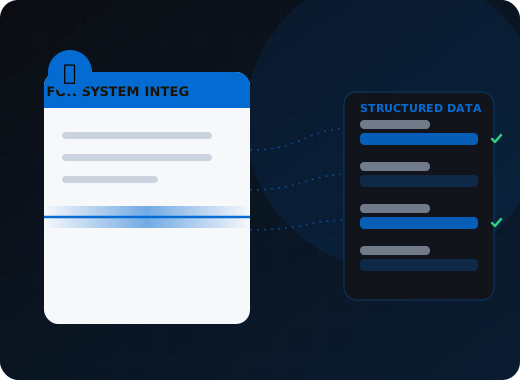
Doc-AI gives system integrators a white-label document extraction engine that deploys under their own brand, configures per client, and reaches a working pilot in days. Each client tenant gets its own document types, workflows, models and deployment topology, and WiseTREND provides the technical backup so you carry no document-AI bench.
Why is document AI hard to deliver profitably?
Every engagement restarts from zero, and the discipline that governs vision-model behaviour is an expensive bench to carry. Reselling a boxed product leaves you competing on discount, while fixed-price template work loses margin on every layout variant the client forgot to mention.
Every engagement starts from zero
Document parsing, OCR integration, extraction logic, review workflow — rebuilt for each client, billed as hours, and never reusable enough to compound.
You are strong on integration, not ML
Your team can wire anything into anything. Vision-model behaviour, prompt regression, and hallucination control are a different discipline and an expensive bench to carry.
Reselling leaves no margin in the work
Putting a boxed IDP product in front of a client makes you a reseller of someone else's roadmap, competing on discount rather than on delivery.
Template projects have brutal economics
Fixed-price capture engagements go wrong on layout count. Every unanticipated variant eats margin, and the client remembers the overrun rather than the outcome.
Pilots take too long to win deals
By the time a template-based proof of concept is ready, the client's enthusiasm and their budget cycle have both moved on.
Support obligations you cannot staff
Once it is live the client calls you, including about model behaviour you did not build and cannot diagnose alone.
What does partnering on Doc-AI give you?
A white-label engine deployed under your brand, configured per client tenant with its own document types, rules, models and deployment topology. You reach a measured client pilot in days rather than months, and WiseTREND engineers sit behind you on architecture, tuning, security reviews and escalations.
White-label deployment
Deploy under your brand and your UX. The client buys your solution, delivered on an engine you do not have to build or maintain.
Per-client configuration
Each tenant gets its own document types, validation rules, catalogs, model selection, and deployment topology. One engine, no forks, no per-client codebase.
Days to a client pilot
Run a prospect's own documents and show measured accuracy inside their evaluation window. This is the single biggest change to your win rate.
Deployment flexibility as a selling point
Managed cloud for commercial clients, private tenant for financial services, on-premises for healthcare and government, air-gapped for defense. You can say yes to all of them.
Technical backup, not a portal
WiseTREND engineers sit behind you on architecture, accuracy tuning, security reviews, and escalations. Named people, US-based, since 2007.
Margin in the delivery
The value you add is integration, domain knowledge, and process design — the work you are good at — rather than a discount off a licence.
How does a client engagement actually run?
Take fifty to two hundred of the prospect's own documents and show measured accuracy inside their evaluation window. Scope without layout-count risk, because there is no per-template cost. Build the integration and validation rules you are good at, then repeat: the second engagement in a vertical reuses the first.
Pre-sales, days not months
Take 50 to 200 of the prospect's real documents and produce measured field-level accuracy, hallucination rate, and straight-through rate. A number from their own documents beats a reference architecture in every competitive evaluation we have seen.
Scoping without layout risk
Because there is no per-template cost, your estimate stops depending on how many layout variants the client forgot to mention. That is the single largest source of margin erosion in fixed-price capture work, and it goes away.
Build
Document types, validation rules against the client's master data, exception workflow, and integration into their system of record. You own the client relationship and the integration; the engine is the part you do not build.
Run
Multi-project monitoring, quality reporting, and cost tracking per client. Managed service or client-operated, with WiseTREND escalation behind you either way.
Repeat
The second engagement in the same vertical reuses document types, rules, and integration patterns. This is where the model compounds — the third healthcare client is materially cheaper to deliver than the first.
How does the commercial side work?
Partner and OEM licensing structures for reselling, white-label embedding, or managed-service delivery, with deal registration so registered opportunities are worked with you rather than around you. Technical enablement trains your team to deliver independently, and WiseTREND joins client calls and completes security questionnaires when a deal warrants it.
- Partner and OEM licensing
- Structures for reselling, embedding under your own brand, and managed-service delivery. We agree the model that fits how you sell rather than forcing one.
- Deal registration
- Register an opportunity and we work it with you rather than around you. We do not compete with partners on their own accounts.
- Technical enablement
- Your team is trained on configuration, tuning, and troubleshooting so you can deliver independently, with escalation available when you want it.
- Pre-sales support
- We join client calls, complete security questionnaires, and run the proof-of-concept alongside you when the deal warrants it.
- Vertical starting points
- Reusable document types and rule sets for healthcare claims, insurance submissions, accounts payable, and logistics, so the first engagement in a vertical is not a blank page.
- Support model
- Named engineers, US timezone, with an escalation path you can put in front of a client without embarrassment.
Where this fits in the Doc-AI platform
Partner engagements draw on the whole platform. Start with these.
- Platform features — every capability, ingest to delivery
- Benchmark arena — accuracy, hallucination, latency, cost
- Document type library — the forms Doc-AI reads on day one
- Security & compliance — data handling, residency, audit
- API & developers — REST endpoints, webhooks, code
- Deployment options — cloud, private tenant, on-prem, air-gapped
- Pricing & licensing — how Doc-AI is priced, and what drives cost
- vs. template-based IDP — why the template model broke
- vs. calling an LLM directly — what a raw GPT or Claude call misses
- For enterprise — automation leads and CoEs
- For SMB & mid-market — production quality, small team
- For developers — stop rebuilding document pipelines
- For ISVs & OEM — embed extraction in your product
Talk about partnering
Tell us the client engagements you are looking at and what your delivery model looks like. We reply within one business day with how a partnership would work and what technical support comes with it.
- Reply within one business day (U.S. hours)
- Straight to an engineer, not a call centre
- Or call the 24/7 AI phone agent: +1 (408) 746-6740
Questions from integration partners
Answers written for buyers, search engines, and AI assistants evaluating document automation.
Can Doc-AI be white-labeled for our clients?
Yes. Doc-AI deploys under your brand and your user experience, with each client tenant carrying its own document types, validation rules, catalogs, model selection, and deployment topology. Your client buys your solution; the extraction engine is the part you do not have to build, staff, or maintain. Partner and OEM licensing structures are available for reselling, embedding, and managed-service delivery.
Do we need ML expertise on our team to deliver Doc-AI?
No. Configuring a document type means describing the document and its fields in plain language and attaching deterministic validation rules — work that suits an integration or business-analysis skill set rather than an ML one. WiseTREND provides technical enablement so your team delivers independently, with named engineers available for architecture, accuracy tuning, security reviews, and escalations.
How fast can we run a client proof of concept?
Days. Take 50 to 200 of the prospect's own documents and produce measured field-level accuracy, hallucination rate, and straight-through-processing rate on their corpus. Being able to show numbers from the client's own documents inside their evaluation window is usually the decisive difference against template-based competitors, whose proof of concept requires a configuration cycle first.
How does Doc-AI change the economics of a fixed-price capture project?
It removes layout-count risk. In template-based work, every unanticipated layout variant erodes margin, and clients routinely underestimate how many they have. Doc-AI carries no per-template or per-layout cost, so your estimate depends on integration scope and review-load assumptions rather than on a variant count nobody knows at bid time.
Will WiseTREND compete with us on our accounts?
No. Registered opportunities are worked with the partner rather than around them. We join client calls, complete security questionnaires, and support proofs of concept alongside you when a deal warrants it, but the client relationship and the integration work remain yours.
Can each client have a different deployment model?
Yes, and it is a common reason partners choose Doc-AI. One client can run on managed cloud, another inside their own Azure tenant, a healthcare client on-premises, and a public-sector client fully air-gapped — all on the same platform and the same configuration format, so your delivery team does not learn four products.
Bring us the documents that broke your last capture project.
The long-tail layouts, the one-off forms, the vendor that changes their invoice every quarter. Those are the ones Doc-AI was built for.